
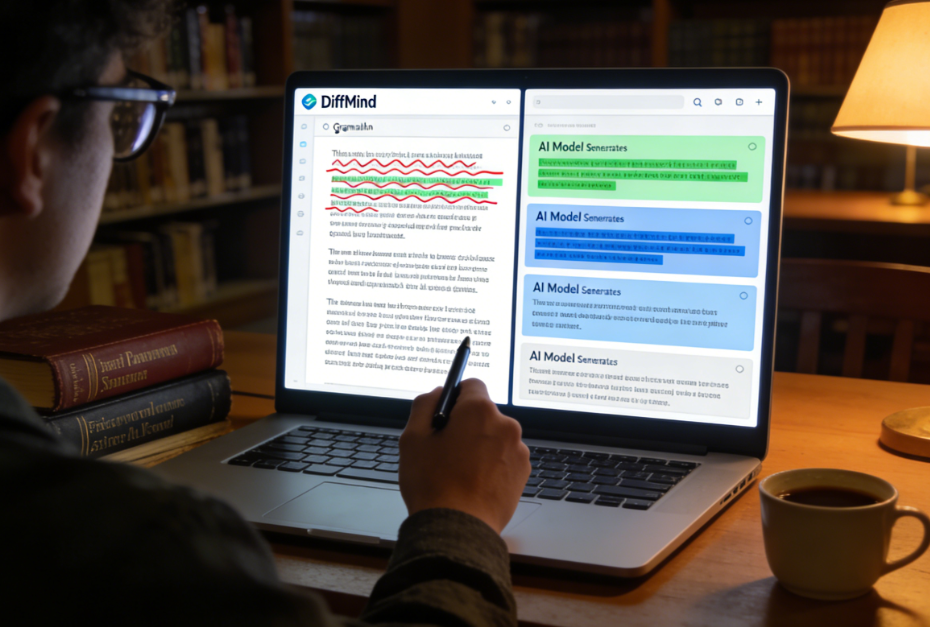
Why is writing a thesis so tiring for one person?
Even when completing assignments independently, you are actually playing multiple roles simultaneously, leading to brain overload:
- researcher: Responsible for finding information and determining viewpoints.
- Writer: Responsible for turning ideas into words.
- edit: Responsible for correcting grammar and enhancing the sophistication of vocabulary.
- Proofreading: This task involves checking citation formatting and logical coherence. When you try to edit as you write, the efficiency is extremely low. Moreover, different AI tools have vastly different styles: some make overly elaborate changes, completely altering the original flavor; others only correct punctuation, failing to address the problem of **Chinglish**.
My "Personal Safety Net Process": A 5-Step Method for Safe and Compliant AI Polishing
To ensure academic integrity, we must make it clear that:AI can only be used for language polishing, not for generating opinions. Here is my safety operating procedure:
Step 1: Identify the original meaning and argument
Before polishing, save your original draft and clarify what the core argument of this paragraph is.
Step 2: Have 6 AIs work in parallel to refine the text in layers.
Don't just give a single instruction like "polish me." In DiffMind, you can have six AIs each perform six different polishing tasks:
- Conservative Grammar Fix: Correct only the mistakes, not the words.
- Academic Tone: Change "I think" to "It is argued that...".
- Concise version (Conciseness): Cut out redundant and unnecessary words to make sentences more concise.
- Native Flow rewriting: The focus is on resolving Chinese-style pairings to make the expression more authentic.
- Logical Flow: Optimize conjunctions (Therefore, However) to enhance coherence.
- Terminology consistency: Ensure that the keywords are consistent throughout the entire text and do not change words randomly.
Step 3: Create a comparison table and select the "most stable version".“
A quick glance will reveal that Claude's revisions may be the most elegant, but GPT-4's are the most rigorous. Choose the version that best preserves your original meaning and reads most smoothly.
Step 4: Human Review
This is the most crucial step. It must be checked personally.
- Facts: Has the data been tampered with by AI?
- Citations: Are the references still there?
- Original Meaning: Do you still hold your core argument?
Step 5: Finalizing the draft
Combine the selected paragraphs to complete the final polishing.
DiffMind Practical application: How to use tools to ensure "academic quality"?
use DiffMind Such Multi-model editing tool (multi-model AI for editing)It can give you a God's-eye view.
1. Parallel editing: Comparing three options is always a good idea.
Enter a string of broken English, and DiffMind will display six suggested changes simultaneously.
- Scene: You wrote the sentence, "People use phone very much."“
- Model A: “"Mobile phone usage is prevalent." (Academic)
- Model B: “There is a heavy reliance on smartphones.” (authentic)
- Model C: “"People use phones a lot." (Too colloquial, eliminated) By comparing, you'll immediately know which one to choose.
2. Enhanced Questioning: Not only knowing what happened, but also understanding why it happened.
Using "question enhancement," the AI is required to output during the polishing process.Reason for modification (Change Log):
- Original sentence: “"Make the result better"”
- Revise: “"Optimize the outcome"”
- reason: “"Optimize" is more academic than "make better"; "Outcome" is more precise than "result" in this context. This not only helps you revise your paper but also helps you build your knowledge base.Personal Expression Lexicon。
3. Avoid excessive rewriting
By comparing multiple models, if a model is found to have added content that you didn't include, it is immediately discarded. This "multi-model verification" mechanism is the best defense against AI hallucination.