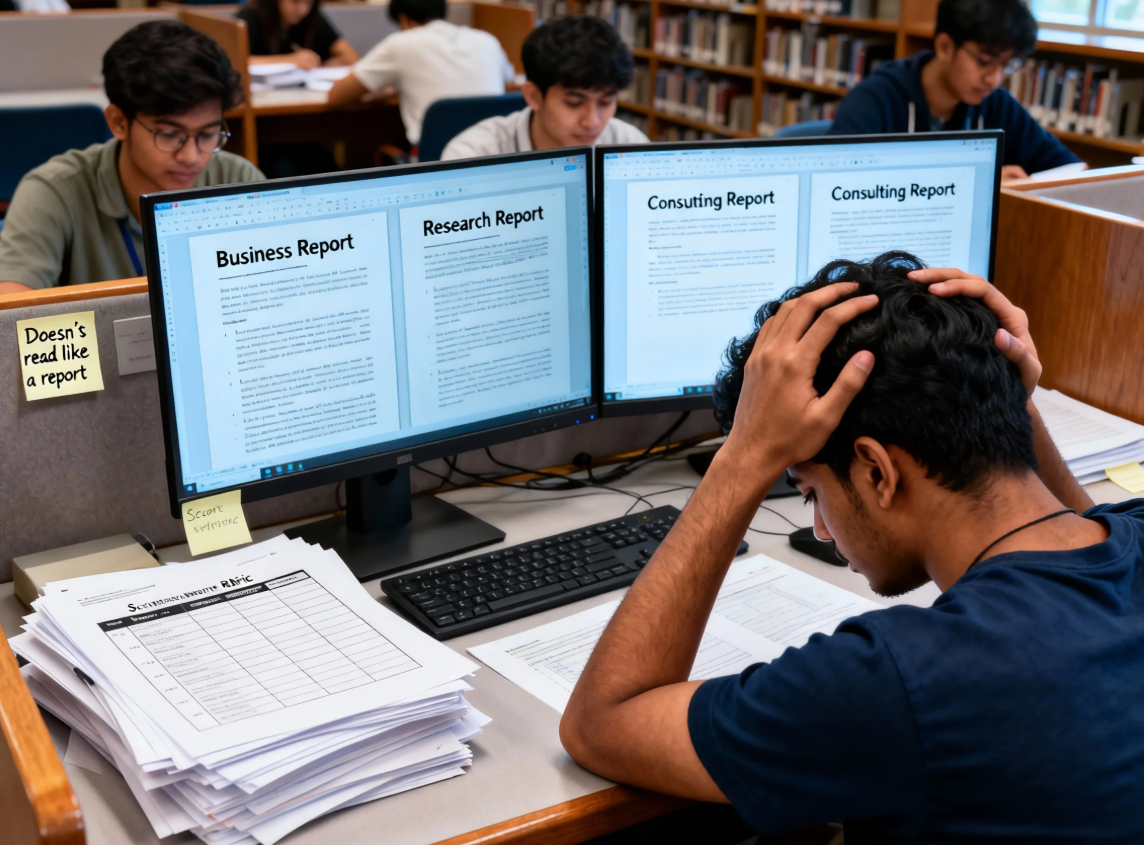

1) The structure collapsed while writing: The most realistic "midway death" moment for international students
You originally just wanted to write a "decent" essay. But halfway through, you suddenly realized:
- It started with A, then changed to B, and finally ended with C.
- Each paragraph is like a collection of "things that I think make sense": a paper today, a case study tomorrow, and then a class note the day after.
- The most jarring thing was the professor's statement:“"You don't have an argument."”(Your essay lacks a main argument.)
Even more frustrating is this: you've clearly written numerous citations and academic terms, and it looks "very academic," but it still doesn't feel coherent. Because the problem is usually not with the language, but rather...Structure—Once the structure falls apart, all the following sentences become “trying to pretend to be an article.”
If you're searching for "essay structure help" or "academic writing for international students," this is for you if you've "gone off-topic halfway through writing."
2) Common Essay Structure Problems Deconstructed: Why Your Hard Work Didn't Make Sense
The following are the most typical structural pitfalls that are most likely to result in points being deducted by the scoring criteria.
Problem A: The thesis is unclear/has too many arguments.
symptom:
- The thesis is a long sentence, but after reading it, you still don't know what you're trying to prove.
- A 1500-word essay tries to cover 7 points, but only touches on each one superficially.
nature: A thesis is "the battle you must win," not "what you know." The more arguments you have, the more it resembles a summary of notes, and the harder it is to form a coherent argument.
Problem B: The paragraph lacks a topic sentence, resulting in an imbalance between evidence and analysis.
symptom:
- Each paragraph does not begin with an opinion, but rather with phrases such as "some people say," "in a certain study," or "in recent years...".
- You cite a lot of sources, but your own analysis consists of only one sentence: "This shows that...".
nature: Paragraphs are not a repository of information, but rather...A small unit of argumentationA lack of a topic sentence will leave the reader wondering what this paragraph contributes to the thesis. Too much evidence and too little analysis will be perceived as "descriptive writing" rather than "critical writing."
Question C: The logic is built up with numerous references but lacks a logical progression with "so what?" statements.
symptom:
- Scholar A says X, scholar B says Y, scholar C says Z, and then you switch to another section.
- The reader has only one thought in mind:So what?
nature: A citation is not a substitute for an opinion. You need to "bridge" each citation: How does it support your opinion? What is its relationship to the previous piece of evidence? What step of reasoning does it advance?
Question D: The conclusion repeats the beginning and does not address the keywords in the question.
symptom:
- The conclusion is simply a rephrasing of the introduction.
- The question asks "To what extent…", but your conclusion does not specify the extent; the question asks for "evaluation", but your conclusion lacks evaluation dimensions.
nature: The conclusion is not a "closing" but ratherFinal delivery as required by the question: Respond to keywords, state the strength of your position, and summarize contributions and boundaries.
3) My "fallback process": From messy drafts to a deliverable version (a lifesaver for international students)
Below is a process you can follow directly. The goal is not to write a literary work, but to save an article from a "structural collapse" to a "deliverable" state.
Step 1: Reverse the question requirements + scoring rubric (don't rush to write it yet)
Break the question down into three types of information:
- Task verbs:discuss/evaluate/compare/to what extent/analyse
- Subject ObjectTheory/Case Study/Period/Group
- LimitationsScope, time, context, variables
Then, by referring to the rubric (or the criteria that teachers often mention), at least confirm the following:
- Is the argument clear?
- Is critical analysis sufficient?
- Is the structure and coherence smooth?
- Is the use of sources reasonable?
The significance of this step: you will know "how I should win," rather than "how much I should write."
Step 2: First, write a thesis statement and an outline of 3-5 main arguments (using the most rigid framework).
Write only one sentence for the thesis section, the more specific the better.Templates can be used as a reference:
- “This essay argues that ___ because ___, particularly in the context of ___.”
- “While ___ appears to ___, a more convincing explanation is ___.”
Next, write 3–5 main points (one sentence for each point), and make sure they are:
- Can directly support the thesis
- They do not overlap.
- There is a natural order (cause and effect/contrast/from macro to micro).
If you can't write 3-5 points, it often means your thesis isn't clear enough; if you write 8, it means you're writing a "course review".
Step 3: Complete each paragraph according to the format of "viewpoint - evidence - analysis - summary" (turn the collage into an argument).
You can use a paragraph checker template to "fix" the draft paragraph by paragraph:
- Topic sentenceWhat is this passage trying to prove? Explain it in one sentence.
- EvidenceLiterature, data, and case studies (1-3 items are sufficient).
- AnalysisExplain how the evidence supports your point of view, at least by writing "therefore/this means/this also shows".
- Summary (Mini-conclusion): This concludes and connects to the next paragraph ("This provides the basis for the discussion of X in the next section").
A very useful proportion reference:Analysis ≥ EvidenceOtherwise you'll fall into the trap of "citation piling up but no result".
Step 4: Check if the paragraph order is progressive (use "structural comparison" to correct the logic).
This step is crucial: you don't just need to "have paragraphs," you need to...The paragraphs can move forward.。
Method: Extract the topic sentence from each paragraph and list it separately. You will immediately see:
- Are there any repeated arguments?
- Did it suddenly jump to a new topic?
- Are there any missing "transition/rebuttal paragraphs"?“
Then do a "structure comparison": fit the same content into different structural schemes and see which one is more like "having an argument".
Commonly used structural schemes for comparison:
- Problem-Cause-Impact-SolutionSuitable for policy and practical suggestion questions.
- PEEL (Point–Evidence–Explanation–Link)Suitable for most general essays
- Theme progressionFrom concept definition → controversy → application → evaluation
- Compare-Contrast StructureA vs B, final overall evaluation
Your goal is not to pursue the "highest level structure," but to choose a structure that can bring your thesis to its conclusion.
Step 5: Finally, standardize the tone, terminology, and citation format (to make it look like it was written by the same person).
After the structure is salvaged, the final step is "polishing" to prevent the following:
- One part is very colloquial, the other is like machine translation.
- The same concept has been called three different names.
- Mixed citation formats (APA/Harvard/MLA conflicts)
Key points to be unified:
- Academic tone (more objective, fewer emotional words)
- Connectives and their application (however, therefore, moreover, in contrast)
- Consistent terminology (definition given upon first appearance).
- The reference list is aligned with the in-text citation.
4) DiffMind How to use "multiple models + structural comparison" to pull a draft back from a disaster to deliverability
If you already have a bunch of drafts/notes/half-finished works, the worst thing is:You know where the problem is, but you don't know where to start fixing it.At this point, "structural comparison + multiple models" will be more like a writing coach than a tool that only allows for continued writing.
4.1 Generating different essay outlines using multiple models (comparing various structures)
DiffMind can generate multiple optional outlines for different models, for example:
- Problem-Solution Version (Suitable for practical problems)
- PEEL version (more stable paragraph execution)
- A progressively structured version (with clearer concepts and controversies).
- Comparative evaluation version (suitable for evaluating/comparing)
When you have the same topic and the same set of materials, you can quickly identify the differences by observing the different structural frameworks.How should I approach writing this so that it flows smoothly?This is especially crucial for supporting international students' writing, because it saves you time on the "trial and error structure."
4.2 One-click splitting of drafts into paragraph structures and marking logical gaps
After you drop your draft in, it can:
- Automatically identify possible topic sentences for each paragraph (or indicate missing ones).
- Mark the paragraphs that have "lots of evidence but little analysis".
- Point out where transitions are lacking and where there are jumps in the argument.
- It is suggested that a rebuttal paragraph or a limiting condition paragraph be added (to make the argument more complete).
The value of this step is that you no longer make changes based on intuition, but rather according to the "structural gap list".
4.3 Automatically unify academic tone, conjunctions, and paragraph transitions.
Once the structure is fixed, DiffMind can proceed further:
- To unify the tone to a more standard academic tone
- Add connecting sentences to create "bridges" between paragraphs.“
- Optimize the use of conjunctions to reduce colloquialisms and repetitions.
- Check for formatting consistency based on your chosen citation style.
If you're looking for AI essay outlines or multi-model writing, this "structure first, polish later" process is less likely to lead to off-topic writing than simply continuing the writing with one click.
5) Self-help Checklist (can be copied and pasted)
Paste the checklist below at the top of your document and check off each item. Many essay score differences stem from these seemingly basic but crucial points.
Essay Structure Help / Self-Help Checklist
- I have circled the keywords in the question (task verbs + subject matter + constraints).
- I can write a clear thesis (position + reasons/scope) in one sentence.
- I only have 3–5 main arguments, and each one directly serves the thesis.
- Each paragraph has a clear topic sentence (not background information or a quote at the beginning).
- Each paragraph satisfies the following structure: viewpoint → evidence → analysis → summary/link.
- The ratio of evidence to analysis is reasonable (analysis is no less than the accumulation of evidence).
- I added counterarguments/limitations at key points and responded.
- The paragraphs are arranged in a progressive order (the logical flow remains even when the topic sentence of each paragraph is extracted).
- The conclusion should address the key words in the title (especially "to what extent" and "evaluate") and clearly state the strength of the position.
- The terminology, tone, and conjunctions are consistent throughout the text.
- The citation format is consistent, and the in-text citation matches the reference list exactly.
In conclusion: Structural comparison is not "rewriting," but rather "turning what you've written into an article."“
Essays often fall apart halfway through writing not because you can't write in English, but because you didn't define your argumentation path before writing the content. By working backward from the topic and rubric to deduce the thesis, and then comparing the structure to choose a framework that can advance the argument, you can transform a patchwork draft into a deliverable essay.
If you often get stuck on "I know I need to revise, but I don't know where to start," then let the tools handle the process: use DiffMind to generate different outlines from multiple models for comparison, then break down the draft into sections to find logical gaps, and finally unify the academic tone and connections—you'll find that rescuing an essay can be much faster than you imagine.