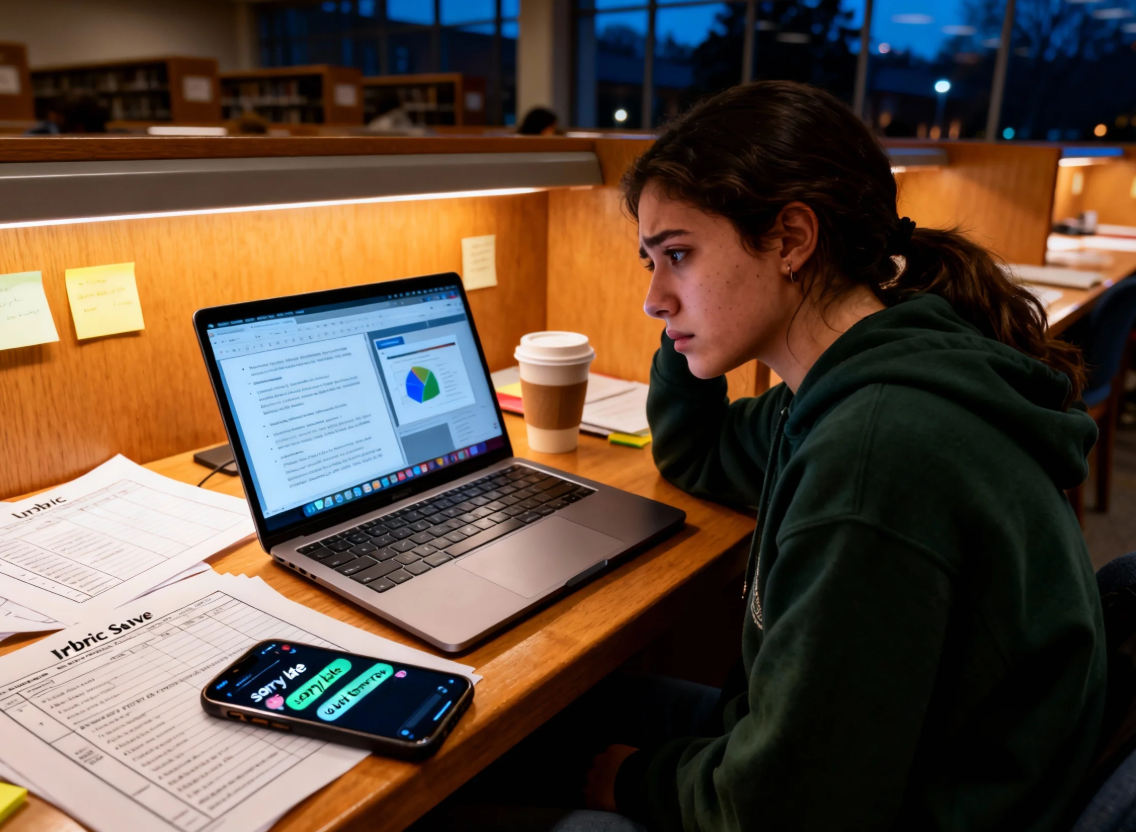
1) A genuine rant: The classic nightmare of group assignments for international students
You might think group projects are about "teamwork and mutual success," but the reality is:
- During the meeting, everyone said, "No problem, I'll do it." After the meeting, the group chat was as quiet as a library at 3 a.m.
- A was in charge of research and submitted two copied and pasted abstracts without any citations; B was in charge of analysis and wrote a 300-word "I think"; C was in charge of slides and created 40 pages of plain text with a color scheme like fluorescent lights.
- The worst part is: 12 hours before the deadline, you find that your content...The logic is flawed, the formatting is inconsistent, and the citations are scattered.The teammate said, "I have something to do tonight, I'll change it tomorrow."
Studying abroad already involves significant language barriers, time differences, and academic pressure; if your team members slack off, you can easily be forced to take on the full workload of "project manager + researcher + writer + designer + presenter." What you need isn't complaining (though it's worthwhile), but a system that allows you to...One person saves the whole processThe strategy.
2) Common problems with division of labor in group projects: It's not that you're being picky, it's a structural failure.
Many group assignments fail not because of "bad teammates," but because the division of labor is inherently prone to problems. Common pitfalls include:
Question A: Dividing tasks by "chapter" inevitably leads to stylistic fragmentation.
Each person writes a section (Introduction / Literature Review / Method / Discussion), and when they are pieced together, it's like four people writing the same article in four different universes:
- The tone of voice differs (some use academic language, others use colloquial language).
- Inconsistent terminology (the same concept is called by 3 different names)
- Logical break (the conclusion of the previous paragraph is not connected to the conclusion of the next paragraph at all).
Question B: Tasks are assigned, but there is no unified delivery standard.
For example, phrases like "You do research," "You handle data," and "You create PPTs" sound professional, but if there are no specific instructions:
- Output format (table? main points? paragraph?)
- Citation format (APA/Harvard/Chicago?)
- Depth criteria (how many papers? Should comparisons be made?)
In the end, all you get is a bunch of unusable, half-finished products.
Question C: There is no "overall person in charge" or "quality acceptance point".“
The most fatal thing is not paddling, but...No one is overseeing it.:
- No unified outline
- No mid-term inspection
- No final integration time
When the deadline arrives and the problem is discovered, it's too late for "collaboration," and the only option is to "save ourselves."
Question D: Additional pain points for international students: higher communication costs
- Language can be easily misunderstood (when you urge someone to submit a draft, it sounds like you're arguing; when you don't, it sounds like you're assuming everything's fine).
- Time zone/part-time job/course conflicts lead to extremely low meeting efficiency.
- Some students are not familiar with academic writing conventions (citations, chains of evidence, argument structure).
3) Individual backup process: Treat the group assignment as "your own project," but have your teammates provide the materials.
Below is a "personal safety net process" that you can directly follow. The core idea is:
You are responsible for structure and quality control; your teammates are responsible for providing raw materials.
This way, even if they slack off, you can still bring the work back to a passing grade in a controlled manner.
Step 1: First, seize control of the framework (to be completed in 10–20 minutes)
The first thing you need to do is not to write, but to produce a workable outline:
- Research questions/topic scope (avoid writing that becomes too scattered)
- The key questions to answer in each section (What/Why/How/So what)
- Expected word count, number of citations, and data/example requirements for each section.
- Define key terms consistently (to avoid confusing concepts).
When sending it to the group, use a tone that says it's "to save everyone time":
“"I've put together an outline. If you fill in the content according to this, it will be easier for us to put it together in the end."”
Step 2: Transform "division of labor" into "acceptable deliverables".“
Don't say "You write a literature review," say:
- Deliverables:3 core references + 5 lines of key points from each + 1 sentence that provides insight into our argument
- Delivery format: Table/Key Points List (for easy integration)
- Deadline: 48–72 hours in advance (allow yourself time for integration and repair)
You're not being the boss; you're reducing rework.
Step 3: Set two checkpoints: a mid-term minor check + a major consolidation before the deadline.
- Mid-term review: Focuses only on "whether materials are available and whether they are usable," without striving for perfection.
- Comprehensive integration: You centrally handle structure, argumentation, language, citations, and formatting.
This step determines whether you can shift from "passively putting out fires" to "actively taking control of the situation".
Step 4: During integration, do only three things: logic, evidence, and consistent style.
When you receive your teammate's work, don't rush to polish it. Process it in order:
- Logical chainIs the conclusion supported by evidence? Does the paragraph answer the questions in this section?
- Evidence and CitationsDoes each key point have a source? Are the citations consistent?
- Expression styleStandardize terminology, tone, sentence density, tense, and format.
Step 5: The final 60–90 minutes: Dedicated to “scoring point alignment”
Use rubrics (scoring criteria) as a checklist:
- Do you respond to the question requirements?
- Is there critical analysis?
- Does it have a clearly structured argument?
- Whether to reference the specification
- Is the PPT/report readable and presentable?
Many group assignments are not bad in content, but rather...The rating points were not aligned.。
4)DiffMind How we can help you: Quickly integrate, patch logical flaws, and unify expression style.
When you're handling everything alone, the most time-consuming part isn't "writing," but rather:Piece together, supplement, modify, unifyDiffMind can significantly save time in these three stages (especially for international students who need group assignment help).
4.1 Quickly integrate other people's content: turn "fragments" into "usable drafts"“
You can put all the key points, paragraphs, and tables your teammates submit into DiffMind and let it work:
- Reorder the content according to the outline you provided.
- Merge duplicate content and delete off-topic paragraphs.
- Convert the "list of key points" into academic paragraphs (while preserving the traceability structure).
What you get is not a "collage", but a...Structured draft。
4.2 Filling logical gaps: Transforming "I think" into "provable arguments"“
The questions that teammates often ask are:
- Only conclusions, no reasons.
- There is only description, no analysis.
- Using concepts before they are defined
You can have DiffMind perform an "argument check":
- Mark whether the claim and supporting evidence in each paragraph match.
- The missing transitional phrase (therefore/however/furthermore) is indicated.
- Suggestions for additional data, examples, or counterexamples.
- Generate clearer paragraph structures (PEEL/MEAL, etc.)
This will transform an article from one that is merely "filling the word count" into one that "earns points".
4.3 Maintain a consistent writing style: Make the entire text sound like it was written by the same person.
The biggest problem with group projects is a lack of consistent style. DiffMind can be used for:
- A standardized glossary (each concept has a fixed English/Chinese expression).
- Consistent tone (more academic / more concise / more persuasive)
- Consistent sentence density (reduce colloquialisms and excessively long sentences)
- Standardized formatting guidelines (heading level, list style, paragraph length)
The final result is that teachers won't think your compositions are "four-part essays" when they read them.
Usage reminder: DiffMind can help you improve your structure and expression efficiency, but you still need to check the citations and facts to avoid inaccuracies or content that does not meet the course requirements.
5) Self-help Checklist (can be directly copied to your Notes)
Here is a self-help checklist for group assignments for international students:
A. Project initiation and site control
- I have received the problem statement and rubric, and I have written out "What problem do we need to solve?" in three sentences.“
- I produced a standardized outline for the entire group (the questions to be answered in each section + the word count range).
- I have defined 5–10 key terms (to avoid confusion of concepts).
- I set two checkpoints: mid-term material inspection + pre-deadline integration.
B. Division of Labor and Delivery
- The division of labor should be written as "acceptable deliverables" (with clear formatting, depth, and citation requirements).
- The deadline must be at least 48–72 hours before the due date.
- I have a "minimum deliverable version" (which can be completed even if my teammates don't submit it).
C. Integration and Repair (One Person as the Core)
- First, align the logical chain: claim—reason—evidence—conclusion.
- Further citations: Key viewpoints all have sources, and the format is consistent.
- Finally, maintain a consistent style: consistent terminology, tone, and paragraph length.
- Use DiffMind to: restructure the data / fill in any gaps / ensure a consistent style (I was responsible for the final verification).
D. Pre-delivery inspection
- The entire text addresses every requirement of the question (aligned line by line in rubric).
- The PPT has a reasonable information density (one key point per page).
- The speech draft has a clear opening, transitions, and a concluding summary.
- The file naming, format, citation list, page numbers, etc., all meet the requirements.
In conclusion: You're not "meddling," you're trying to save your life.
When you encounter a teammate who's not putting in the effort during a group project, the most realistic approach is to treat it like a "project you lead," letting your teammate provide the raw materials while you focus on the structure and quality. This way, you can maximize the control over the outcome and minimize communication costs.
If you frequently need help with group assignments, especially as an international student, it's recommended to make "backup process + tool integration" your reusable template: next time you won't be dragged down by deadlines again.