Why does your literature review sound like a menu?
Most international students literature review help international students The search for shortcuts overlooked the methodological flaws:
- Ineffective close reading: There simply isn't enough time to read each one from beginning to end.
- Notes on an isolated island: The notes I read lacked structure and only contained scattered highlights, making them unusable.
- Lack of synthesis: The inability to distinguish between academic consensus and debate leads to excessive citations.
- Gap not found: Because there is no horizontal comparison, it is impossible to see the gaps in previous research, resulting in a lack of basis for one's own research topic.
We need a system that can process documents like an "assembly line". academic reading workflow。
Personalized backup process: A 5-step approach from PDF to Lit Review
In the AI era, reading documents is no longer a test of physical strength, but a test of "information architecture ability".
Step 1: Establish a strict "entry mechanism"“
Do not open and read immediately. First, set inclusion/exclusion criteria.
- Read-only: Articles from the past 5 years, published in core journals, with methodologies similar to or completely opposite to mine (for comparison).
- Do not read: The title contains relevant keywords but falls under a different field and is not an empirical study (unless it is a review article).
Step 2: Creating a "Structured Extraction" Card
This is the core step. Don't read the entire text; only extract the six key elements. Use AI to assist in extraction, and each document must generate a card:
- RQ (Research Question): What problem are you trying to solve?
- Method: What model/data/experimental design was used?
- Key Findings: What is the core conclusion? (Avoid minor details)
- Limitations: The author's own description of limitations (this is a goldmine for finding gaps).
- Quote: The most brilliant sentence in the original text (for direct quotation).
- Tags: Your custom tags (e.g., # Qualitative Research # Consumer Behavior).
Step 3: Construct the Thematic Matrix
Open Excel or Notion; the horizontal axis represents the paper, and the vertical axis represents the theme. Do not write the review in chronological order; instead, organize it by…themeWrite it down. For example, regarding the "impact of variable A on variable B," Paper 1 shows a positive correlation, Paper 2 shows no correlation, and Paper 3 shows a negative correlation. Fill these viewpoints into a matrix, and you can immediately see the points of contention in academia.
Step 4: Identify "conflicts" and "gaps"“
Based on matrices, find three types of relationships:
- consensus: What do people all agree on? (This is the background)
- conflict: Why do Paper A and Paper B reach opposite conclusions? (Is it because of different samples? Different methods? This is the starting point for your analysis.)
- Blank (Gap): Is there anything no one has ever done before? (This is your thesis).
Step 5: Output paragraph frames
Directly apply the formula to write a Lit review:
- Concept Introduction -> Mainstream viewpoint (consensus) -> Academic debate (conflicting evidence A vs B) -> The existing research gap is insufficient. -> How does this study fill the gap (My Approach)?。
DiffMind Practical Application: Doubling Reading Efficiency with Multi-Model AI
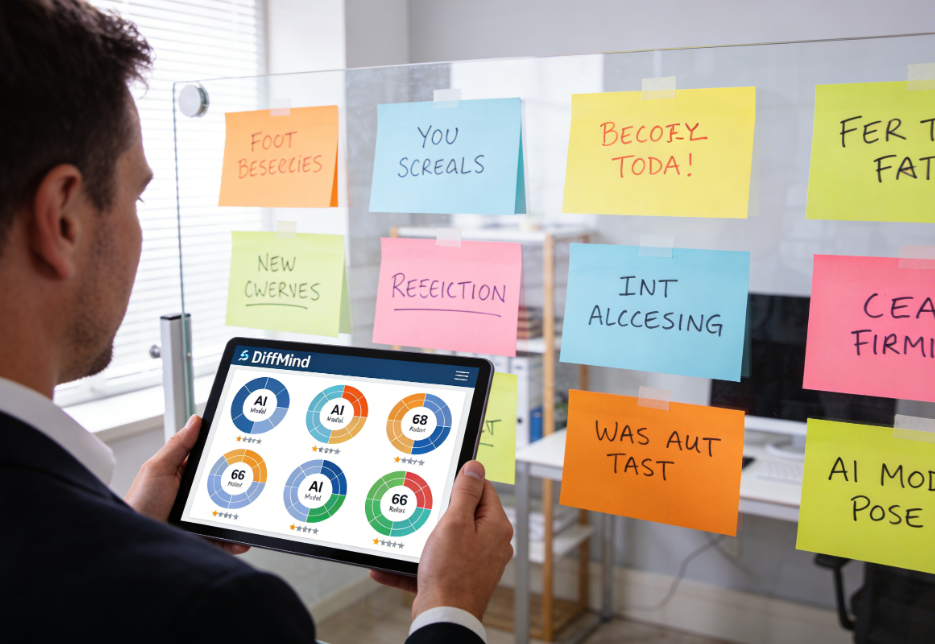
Manually creating cards and matrices is still tiring. At this point,DiffMind(Multi-model AI comparison tool) can become your top choice research paper summarizer for students。
1. Enhanced Questioning: Reject "Summarize the whole text for me"“
If you simply ask an AI to "summarize this article," it will give you a bunch of nonsense. (DiffMind's...)Enhanced QuestioningThis function can automatically optimize your instructions into structured extraction instructions:
- Before optimization: “"Summarize this paper."”
- After optimization: “"As an academic research assistant, please read the uploaded text and output JSON format notes strictly according to the following fields: 1. Research question; 2. Methodological details (sample size, analysis tools); 3. Core conclusions (with data support); 4. Clear research limitations. Retain the original English terms for 2-3 key terms." This will allow you to grasp the skeleton of a paper in 3 minutes.
2. Multi-model comparison: reducing the risk of "misinterpretation"
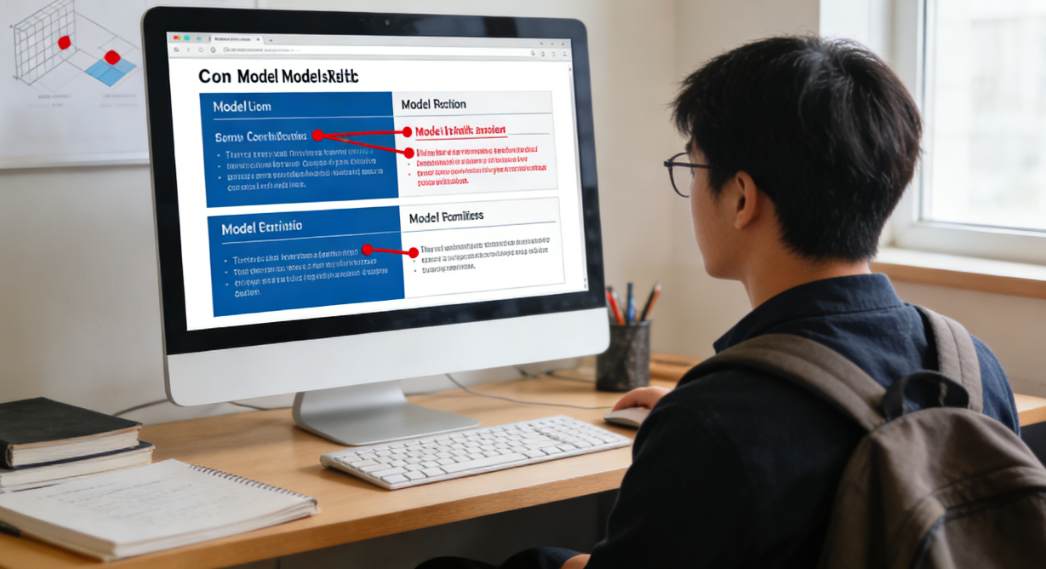
AI can also make hallucinations. Some complex statistical methods can be misinterpreted by a single model. In DiffMind, you can simultaneously analyze the same challenging paper using GPT-4o, Claude 3.5 Sonnet, and Gemini Pro.
- GPT-4o Skilled at extracting data and conclusions.
- Claude 3.5 Skilled at capturing logical flow and implied meaning from the author.
- Comparative reading: If the three models interpret the "conclusion" in the same way, you can cite it with confidence; if they do not, this is the paragraph that you need to read carefully by hand.
3. Cross-validation to find gaps
This is the most advanced approach. Feed the abstracts of 5 relevant papers to DiffMind to enable multi-model mode:
- instruction: “"Based on the content of these 5 papers, please identify their common methodological flaws and derive 3 potential research gaps." Let AI help you make cross-reviews; you'll find that it can uncover blind spots that humans easily overlook through "cross-reviewing."
Conclusion
Reading 50 papers in a week isn't a myth, provided you stop reading them like novels and starts processing them as data. This is achieved by establishing a structured... academic reading workflowBy using DiffMind for precise information extraction and comparison, you will transform from a passive "reader" into an active "evaluator." This is the ultimate secret to getting high scores in Literature Review.