
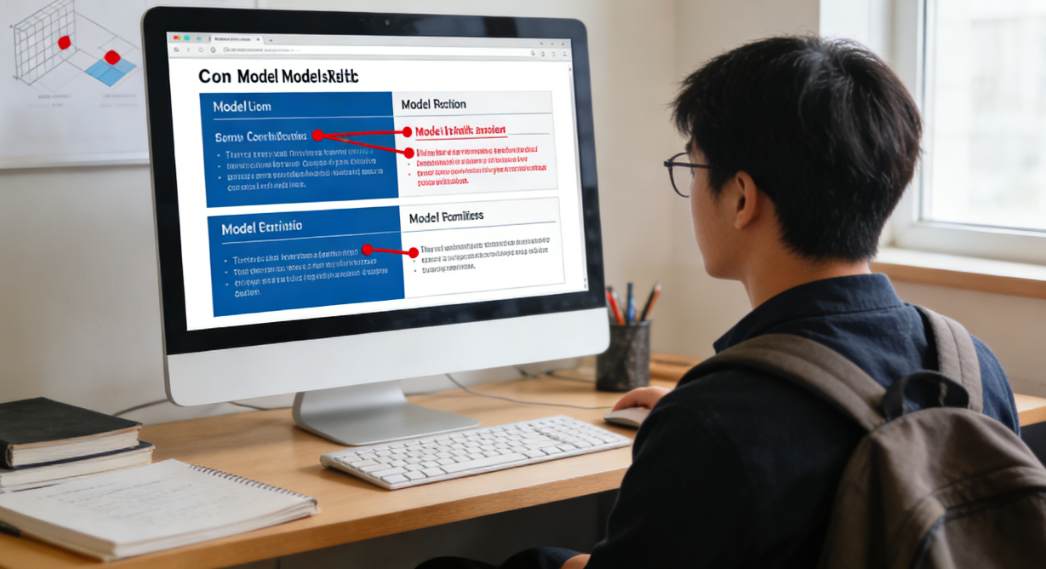
1) Why is something that "seems reasonable" more dangerous?
In work and decision-making scenarios, common AI outputs include: market analysis, user profiling, competitor comparison, growth suggestions, and explanations of technical routes. The problem lies in:
- A smooth and fluent argument does not equate to accurate data.
- Logical completeness does not guarantee that the premises are true.
- Using technical terms does not guarantee reliable conclusions.
Especially when you are short on time and have a heavy workload, it is easy to mistake "text that looks like an answer" for "usable evidence".
2) The core of cross-validation: bringing uncertainty from the shadows into the light.
Multi-model comparison doesn't give you the "final correct answer," but rather breaks down the problem into three layers:
- High consensus zoneConclusions or steps consistently mentioned by multiple models (can be temporarily adopted).
- Low consensus zoneConflicting viewpoints or differing interpretations between models (must be verified)
- blank areaThe models generally do not cover or only vaguely address key points (you need to ask further questions or provide additional information).
Once these three layers are clear, you can allocate your energy more quickly: which to do first, which to do later, and which to find original data for.
3) A practical "multi-model validation process" (which can be directly applied)
Step 1: Ask the same question and provide the "prerequisites and limitations".“
Don't just ask "how to do it," ask "under what conditions does it hold true?" Differences in how different models describe the premises are often the source of risk.
Step 2: Break down the conclusion into verifiable assertions
For example, the statement "a certain channel is more suitable for conversion" can be broken down into: audience matching, cost range, content format, and expected cycle. The more verifiable the assertion, the less likely it is to be misled by empty words.
Step 3: Examine the points of disagreement and ask follow-up questions about the "type of evidence".“
Ask them what each of these is based on: experience, logical deduction, or data? What you need is not more paragraphs, but the "form of evidence."
Step 4: Use your materials to create the final round of constraints.
Put back the known, accurate information: budget, timeline, compliance requirements, and existing resources. Recalculate the solution under constraints and see if it remains consistent.
4)DiffMindAdvantages of comparative analysis in decision-making scenarios
- Reduce platform switchingAsking a question can reveal multiple perspectives.
- It is easier to find blind spotsThe point of contention is your "checklist".“
- Help organize discussionsDuring team reviews, it allows for faster alignment on "where the controversy originated."“
- Transforming AI from an answer generator into a comparison platformYou no longer simply receive, but review and select.
5) Typical Applicable Tasks
- Proposal review: activity strategy, content direction, product positioning
- Research and Analysis: Concept Explanation, Comparative Framework, Hypothesis List
- Technical communication: Advantages and disadvantages of different routes, and boundary conditions
- Risk identification: compliance, public opinion, and feasibility of implementation (further professional verification is required).
In conclusion: What is truly reliable is not "a certain model", but your verification mechanism.
When you make cross-validation a habit, the value of AI becomes more stable: it provides multiple possibilities, and you are responsible for establishing the decision-making loop. Multi-model comparison is a way to significantly reduce the cost of closing the loop.