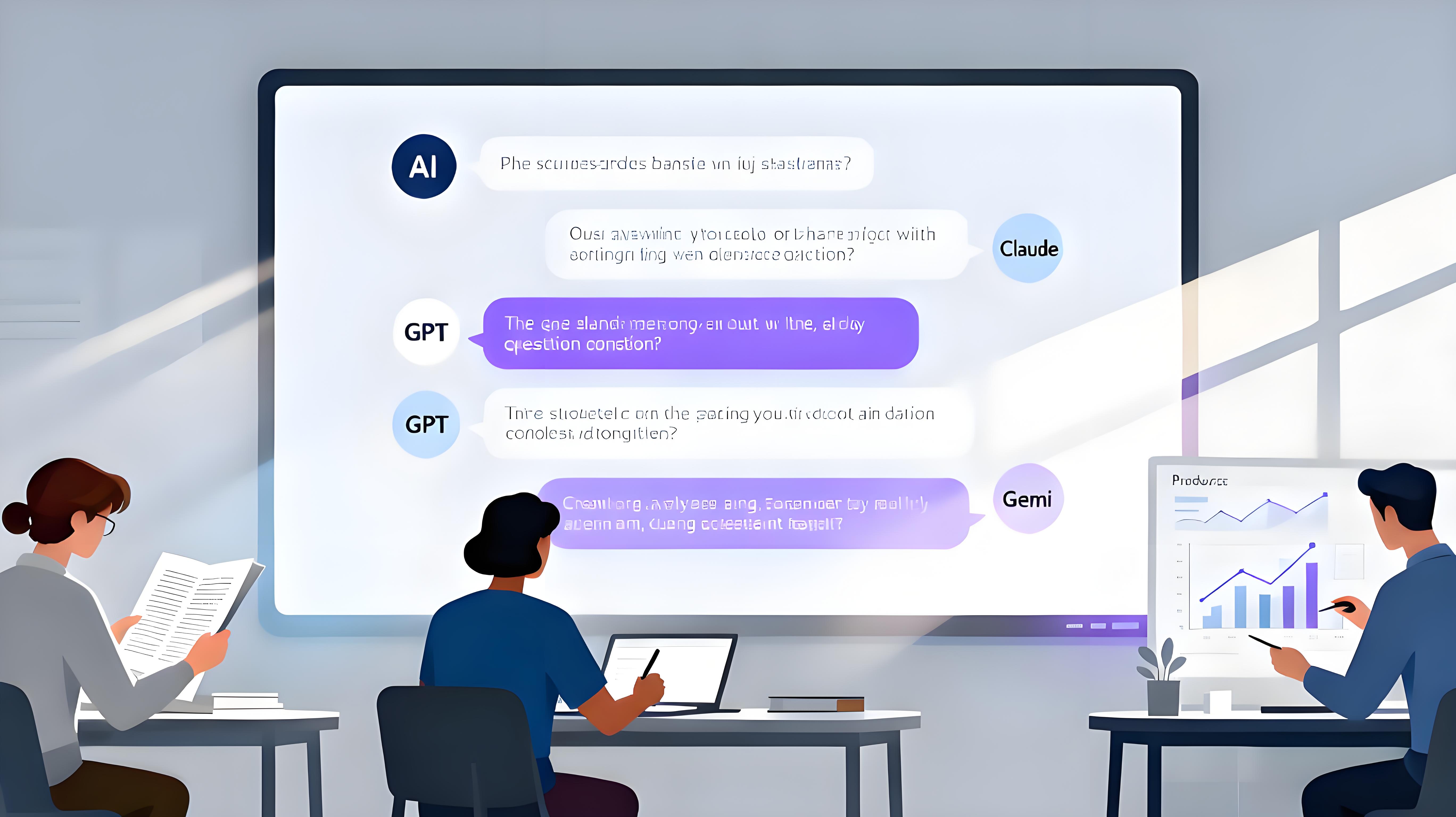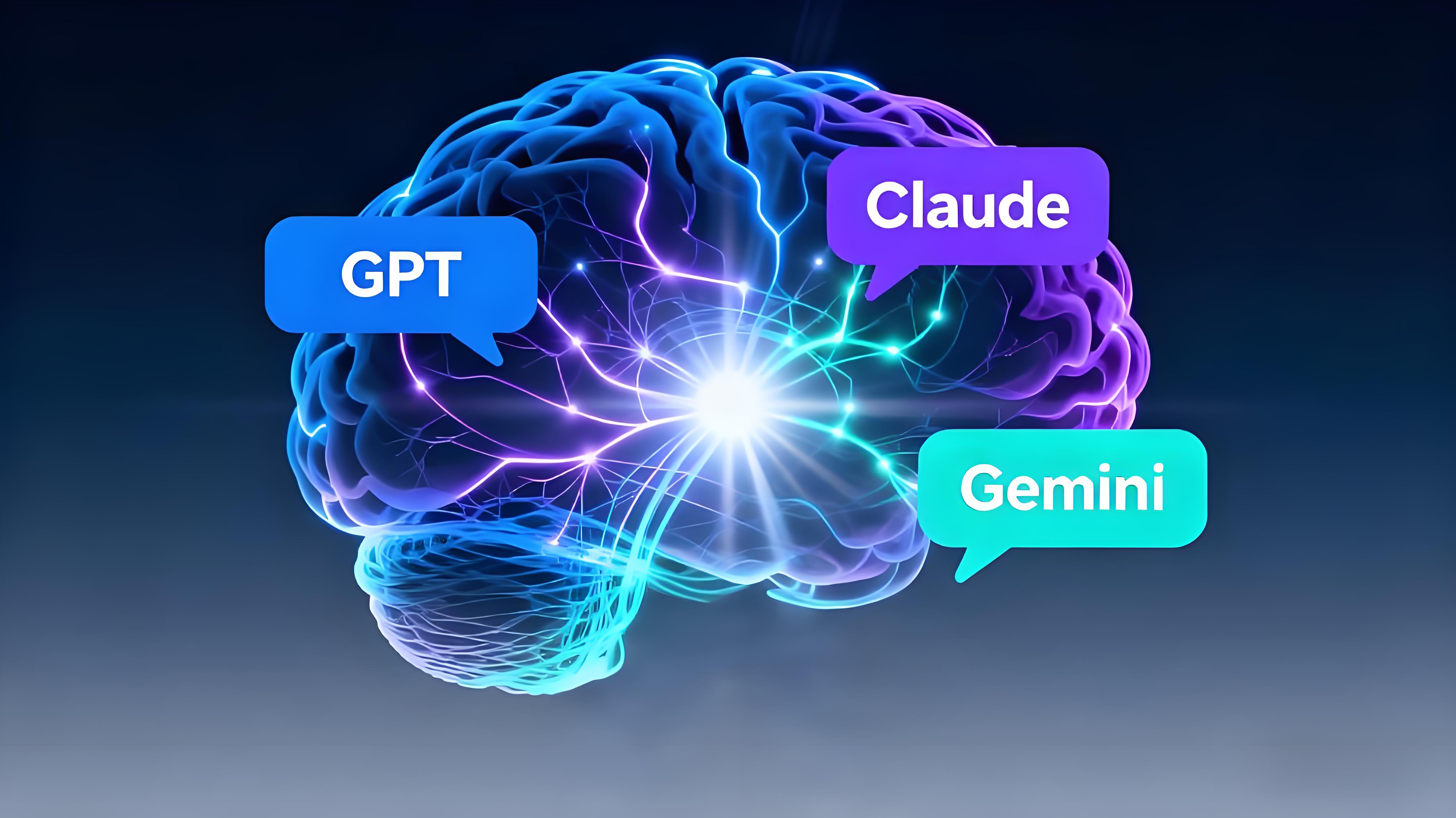
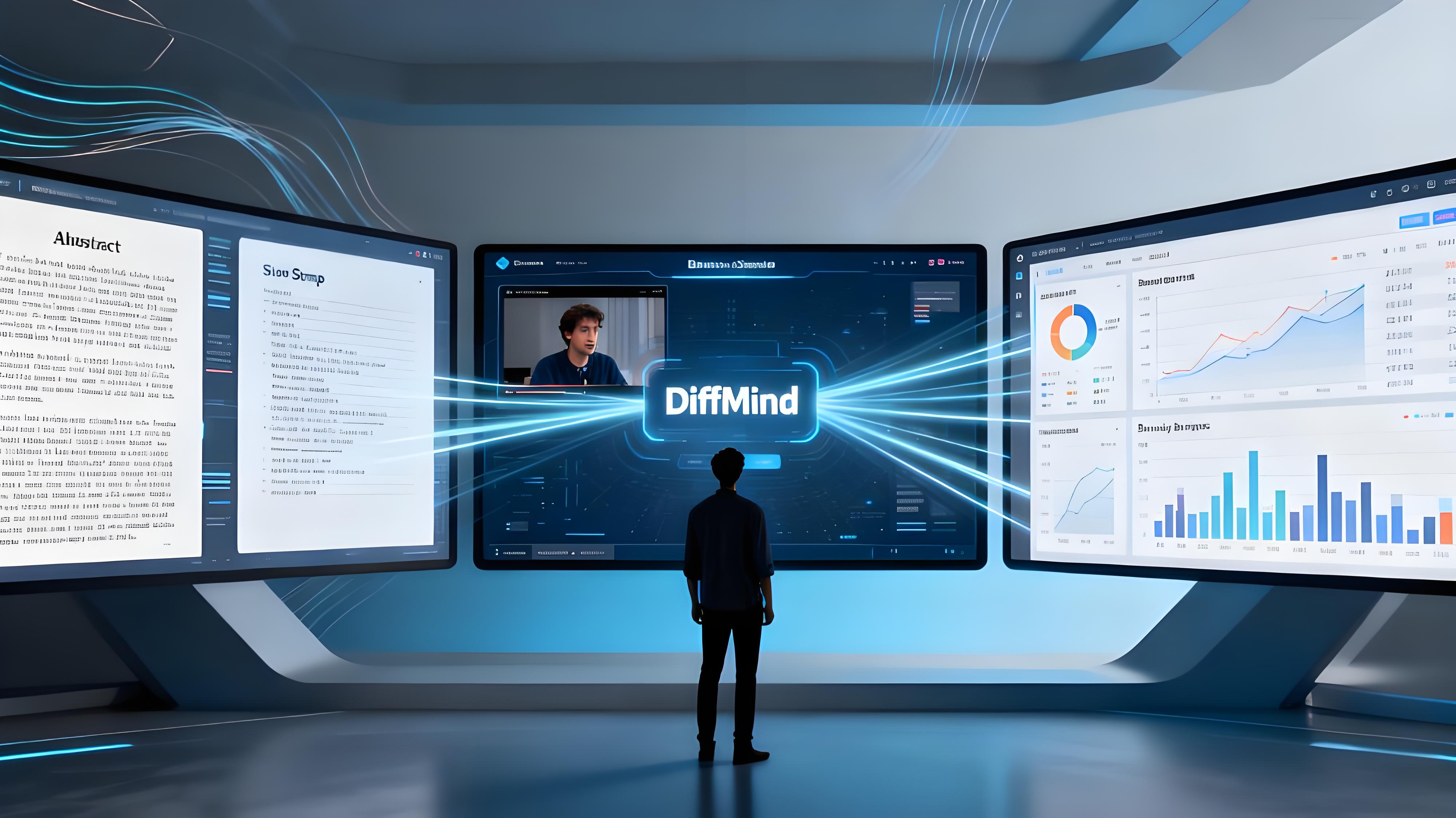
Last week, I helped a friend revise his thesis. He initially relied solely on GPT, and when writing about the "AI multi-model comparison trend," it was all theoretical framework. He didn't even provide examples to explain "why multiple models can improve accuracy." His advisor immediately rejected it, asking him to "add a real-world scenario." Later, he used DiffMind, submitted the question, and saw the responses from GPT, Claude, and Gemini models simultaneously. He then realized that by relying on just one AI, he had completely overlooked the "real-world needs."
Many people are making a mistake when using AI: choosing only one model, resulting in answers that are like "walking with one eye"—not comprehensive enough and prone to "getting stuck on a single point."
I. Common Issues with Current Uses of AI
Are you like this too?
- When writing a paper, only GPT was asked to provide an outline, resulting in rigid logic and a lack of supporting examples.
- When shooting short video scripts, they relied on Gemini to write jokes, but forgot about the details of dissemination, such as "whether users will share it after watching it";
- When developing the plan, Claude was asked to write the emotional copy, but the cost data and implementation steps for DeepSeek analysis were missing.
A single AI is like a "knight-errant who only knows one martial art": it can help you build a foundation, but it can't provide ideas for "breaking through from multiple perspectives".
II. DiffMind in a succinct definition: A multi-model comparison workbench; ask a question once, get solutions from multiple perspectives.
DiffMind It's not about "replacing GPT/Claude," but rather about giving you "multiple AI assistants with different styles simultaneously": you ask a question, and GPT's rigorous logic, Claude's emotional resonance, Gemini's creative quirks, and DeepSeek's technological implementation will all appear before you at the same time. You don't need to switch platforms; you can directly "piece together" the answer that best suits you on the same interface.
III. Three real-world scenarios: How does DiffMind address the "limitations of a single AI"?
Scenario 1: Thesis Writing – Overcoming "Logical Blockage + Insufficient Case Studies"“
TaskWhen writing the section on "The Value of Multi-Model AI Comparison for Academic Research," you need supporting arguments, case studies, and data.
Pain points of not using DiffMindIf you only let GPT write, it will say "multi-model comparison can improve the credibility of the conclusions", but you don't know "how exactly it can improve". When your supervisor asks "give an example", you can only stare blankly.
Using DiffMind's workflow:
- Prompt"To analyze the value of multi-model AI comparison in the argumentation of a paper, it is necessary to divide it into 2-3 sub-arguments, each sub-argument should be accompanied by a real case (such as a university's research on using multiple models to assist in the paper), and the data sources should be clearly marked."“
- Differences in responses from different models:
- GPT(Leaning towards rationality):
“"Sub-argument 1: Improve the robustness of conclusions (for example: a medical paper compared GPT/Claude and found that the error rate of a single model for 'rare disease diagnosis' was 20%, which was reduced to 5% after cross-validation with multiple models); Sub-argument 2: Enrich the dimensions of argumentation (for example: historical papers use multiple models to supplement the interpretation of different historical materials). However, the case only mentions the academic scenario and does not describe the specific operational steps."‘ - Claude(Focusing on details):
“"Sub-argument 1: Avoid the 'AI illusion' (Example: A sociology paper used multiple models for comparison and found that when using GPT alone to describe the 'size of a certain group,' the data bias reached 30%, while the data from multiple integrated models was more accurate); Sub-argument 2: Emotional expression (Example: A paper used Claude to describe the 'significance of the research,' which was more empathetic than GPT). However, the examples are too general and lack data sources."‘ - Gemini(Focusing on propagation):
“"Sub-argument 1: 'AI detective' mode (example: using 'GPT for the logical framework + Claude for the case details + Gemini for the conclusion visualization', a team completed the original draft of a paper in 3 days, which originally took 1 week); Sub-argument 2: 'Young people are more willing to believe in multi-model analysis' (example: data from a journal shows that papers citing multi-model analysis received 40% more likes from young readers). However, the academic rigor is insufficient."‘
- GPT(Leaning towards rationality):
- Comparison and SelectionYou'll find that GPT's logic is the most solid (specific case studies, clear data sources), Claude excels at adding details (such as "emotional expression"), and Gemini is suitable for raising communication angles (such as "young readers' preferences"). The final summary is: "Sub-argument 1 (robustness, GPT case studies) + Sub-argument 2 (detailed completion, Claude analysis) + Sub-argument 3 (communication value, Gemini data)," which the tutor praised as "vivid and compelling."
Scenario 2: Short Video Scripts – Solving "Creative Drain + Distribution Loopholes"“
TaskWrite a 30-second TikTok script for college students on the theme of "Rejecting Involution," making it interesting, relatable, and encouraging users to share it.
Pain points of not using DiffMindIf you ask Gemini to write it, it will say "use the 'involution is not as good as lying flat' meme", but it doesn't write "whether students will feel 'too depressing' after reading it", nor does it consider "reasons for forwarding" (such as "dare to @ your involution king deskmate?").
Using DiffMind's workflow:
- Prompt"Write a 30-second Douyin script with the theme 'Reject Involution,' targeting users aged 18-22. The dialogue should be conversational and internet-savvy, and the ending should encourage sharing (e.g., tagging friends/adding the hashtag). The length should be controlled between 28-32 seconds."“
- Differences in responses from different models:
- GPT(Prefers to be safe):
The opening line reads: "Sisters, do you wake up every day anxious, wondering if you have to roll up your clothes again today?" The middle line reads: "Actually, 'lying flat' is not giving up, it's 'the freedom not to be held hostage'." The ending line reads: "Forward this to your friend who always says 'I can't roll up my clothes anymore,' and let's 'win without lifting a finger' together~" But the script is too conventional, lacks online appeal, and the forwarding prompts are awkward. - Claude(Emotionally-oriented):
The opening line reads: "'Involution' is like a whirlpool, suffocating us? But have you noticed? The flowers by the roadside never 'compete to see who blooms first'." The middle line states: "We are not 'kings of involution,' we are 'protagonists of our own lives'." The ending line, "@Your most 'involutionary' friend, let's 'slow down' life together." It has a story-driven feel, but the ending's guidance isn't direct enough, and young people might not get it. - Gemini(Focusing on memes):
The opening line reads: "Family members, who understands this?! Getting caught up in studying early in the morning, getting caught up in doing homework late at night, even getting caught up in 'eating fast'?!" The middle line continues: "Stop being caught up in! You can 'play it easy,' but you can't 'lie flat'—playing it easy means 'I don't want to be caught up in, whatever,' lying flat means 'I have my own rhythm.'" The closing line concludes: "Dare to @ your 'catch-up king's deskmate? Let him see the daily life of the 'anti-catch-up champion'!" It's trendy and encourages interaction through reposting, but lacks emotional depth.
- GPT(Prefers to be safe):
- Comparison and SelectionYou'll find that GPT's safety (compliant dialogue), Claude's emotions (resonance), and Gemini's use of memes (strong spread) are all advantages. The final result is: "Use Gemini's opening meme → Claude's definition of 'giving up/lying down' → GPT's direct forwarding guidance." The script is both interesting and has attitude, and it was forwarded 12,000 times the day after it was released.
Scenario 3: Business Solution – Addressing “Mistakes in Detail + One-Sided Thinking”
TaskCreate a "Guochao (national trend) marketing plan" for pet supplies with a budget of 500 yuan, emphasizing "differentiation" and "spreadability".
Pain points of not using DiffMindIf you ask Claude to write it, it will say "pet Hanfu + traditional cultural stories", but it won't mention "how to allocate the 500 yuan budget" or "where to find a factory to produce it". You have to check suppliers yourself, which wastes 2 days.
Using DiffMind's workflow:
- Prompt"Write a marketing plan for pet trendy products (such as collars/stickers) with a budget of 500 yuan. The target users are college students who own pets. The plan should highlight 'Chinese trendy products + cost-effectiveness'. It needs to include a breakdown of the timeline (such as product selection/design/promotion), a detailed budget allocation (total cost not exceeding 500 yuan), and suggestions for promotion channels (Xiaohongshu/Douyin)."“
- Differences in responses from different models:
- GPT(Falling off course):
The project timeline is divided into "product selection (1 day), design (2 days), and promotion (3 days)". The collar cost 250 yuan (wholesale from 1688), the stickers cost 100 yuan (customized from a local printing factory), and the promotion budget is 150 yuan (collaboration with Xiaohongshu KOCs). However, the specific selection criteria for promotion channels were not mentioned (e.g., "choose 'pet bloggers' or 'campus bloggers'"). - Claude(Emotionally-oriented):
Using the story of "pets and owners 'wearing the same Chinese trendy clothes'", the title is "'Pet and human matching' 20 yuan Chinese trendy collar, let you and your master be 'trendy' together", with a budget of 480 yuan (collar 200, stickers 100, KOL collaboration 180), but without mentioning the production time and cost details, it is easy to be ripped off by the supplier when it comes to implementation. - DeepSeek(Data-driven):
Analyzing the "student pet market," it was found that the "cute pets" topic on Xiaohongshu garnered 5 billion views in 30 days, and the "pet outfits" videos on Douyin had a high interaction rate of 20%. It was suggested that "product selection should use 'mythical beasts from the Classic of Mountains and Seas' stickers (cost 1 yuan/piece), and collars printed with 'My Cat Master' (selling price 29 yuan, profit 28 yuan/piece)." The entire budget was allocated to advertising, without considering inventory risk.
- GPT(Falling off course):
- Comparison and SelectionBy integrating GPT's project timeline and budget details, Claude's emotional headlines, and DeepSeek's data-driven product selection, the solution was both practical and impactful. The entire 500 yuan budget was used up, leaving 20 yuan in reserve.
IV. Not using DiffMind vs. using DiffMind: The difference isn't efficiency, but the "completeness of the thinking perspective."“
When not using DiffMind:
- You can only get a "one-sided answer from a single model", such as a paper without case studies, a script without details, or a solution that omits costs;
- When you encounter contradictory AI answers (such as GPT saying "make a collar" while Claude says "make a sticker"), you can only "choose based on your gut feeling" and end up "falling into a trap";
- It took 3 days to compile an AI answer, only to have the tutor/client reject it with a single sentence: "This is not what I want," resulting in a rework rate of 80% (%).
After using DiffMind:
- You can "integrate answers from multiple perspectives at once," such as a paper with logic, case studies, and communicative value; a script with humor, resonance, and interactivity; and a solution with budget, channels, and product selection details.
- When encountering contradictions, DiffMind will help you label "what this model is good at" and "where that data comes from," so you only need to "nod and choose the direction," without having to guess;
- What used to take 3 days can now be done in 1 day, and the "multiple perspectives" make the plan/paper/script more competitive—after all, "comprehensive thinking is the best competitive advantage."
V. Summary
DiffMind doesn't "help you use more AI," but rather "helps you use AI smarter." It's like a "multi-perspective thinking assistant": you make your request, and it provides you with a "rigorous framework" from GPT, "emotional resonance" from Claude, and "inspiration dissemination" from Gemini. Finally, you "build blocks" to combine these advantages and get an answer that is "10 times better than a single AI."
The next time you're writing a paper, shooting a video, or making a plan, don't let a single AI be your "only brain"—try DiffMind and let "multiple perspectives" help you turn the "ordinary" into the "amazing".