Many international students easily fall into the following traps when choosing a topic, leading to an extremely painful writing process:
- Interest ≠ Feasibility: You are interested in "Mars colonization," but you can't get your hands on the data.
- Missing operable variables: The question is full of abstract nouns (such as "impact" and "development"), without any specific X (independent variable) and Y (dependent variable).
- Data unavailable: I chose a question that required confidential internal company data to answer.
- The innovation is a false innovation: Thinking that something that no one has written before is innovative is actually because that direction simply doesn't work.
- Method mismatch: I wanted to do qualitative analysis, but I chose a topic that required running big data.
You need a system that can help you turn your "brainstorming ideas" into "implementation plans".
5 steps to select the questions you can finish writing.
In the age of AI, stop speculating alone. Use this process to let AI help you verify feasibility:
Step 1: Identify "Resource Constraints"“
Before asking AI questions, list your cards:
- time: Only 2 months.
- Data capabilities: They can only use Excel to do simple regressions, or they are only good at interviews.
- Word count: 10,000 words.
- field: Marketing / Behavioral Finance / Cross-cultural Management
Step 2: Generate 10 candidate questions and then "brutally score" them.“
Don't just generate one, generate ten. Then ask the AI to score them according to a uniform standard (1-5 points):
- feasibility(Is the data easy to find?)
- Academic contributions(Is there a gap?)
- Writing difficulty(Is it easy to get writer's block?)
- Risk coefficient(Is it easy to go off-topic?)
Step 3: The "Devil's Advocate" of the Top 3
Select the three questions with the highest scores and let AI act as the "most challenging defense judges":
- “"Please identify the most fatal logical flaws or execution obstacles in these three questions."”
- If the AI says "data is difficult to obtain," give up decisively and don't take any chances.
Step 3: Landing as a "four-piece set"“
A good topic must be able to be broken down into:
- Research Question (RQ): A specific question that begins with "How" or "To what extent".
- Hypothesis/Proposition: Can you guess what the answer is?
- Method: What tools (questionnaires/interviews/secondary data) should be used?
- Data Plan: Where can I download the data? Who should I interview?
Step 4: Output a one-page draft (One-pager)
Finally, generate a one-page draft that includes background, gap, problem, methodology, expected contribution, and risk control, and send it directly to your supervisor.
DiffMindLet 3 AI models "fight" for you.“
Why is it recommended? DiffMindBecause a single model (such as using only ChatGPT) can easily lead you astray and create an "illusion." DiffMind, however, allows you to call multiple top-level models simultaneously (such as GPT-4o, Claude 3.5, Gemini), leveraging their different characteristics.Contrast and confrontation。
1. Multi-model brainstorming: Avoiding limitations in thinking
Enter your broad ideas (such as "the application of AI in education").
- GPT-4o The questions may be very standard and structured.
- Claude 3.5 They might present more in-depth and critical questions.
- Gemini It may incorporate the latest search trends to create novel topics. DiffMind's advantages: One question yields three dimensions research topic ideas international studentsYou can combine them to find the best solution.
2. Enhanced Questioning: Automatically adds constraints, rejecting overly broad questions.“
You might have only typed "Give me a business topic." (DiffMind)Enhanced QuestioningThe feature will automatically complete the Prompt for you: "As a business school mentor, please propose five suitable master's thesis topics in the field of 'digital transformation.' Requirements:"The data is publicly available (such as listed companies' annual reports), the methodology is quantitative analysis, and the focus is on small and medium-sized enterprises.”This directly helps you avoid the risk of the topic being "too big".
3. "Colosseum" Mode: Models clash, rapid iteration
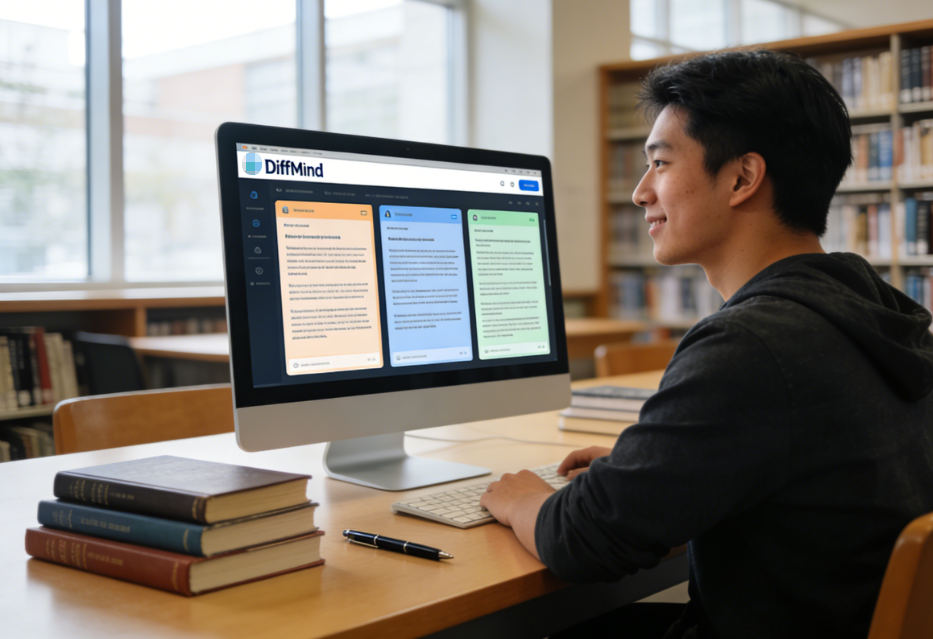
This is the most brilliant use case. Utilizing DiffMind's multiple model windows:
- Window A (GPT-4o): Propose a specific research proposal.
- Window B (Claude 3.5): The instruction is: "You are a strict reviewer, please criticize Window A's proposal harshly and list three reasons why it is not feasible."“
- Window C (Gemini): The instruction is to "modify the design of window A based on the criticisms of window B, making it more perfect."“
Through this closed loop of **"propose-criticize-revise"**, you no longer get a random idea, but a mature topic that has undergone rigorous logical testing.
Conclusion
Topic selection isn't based on inspiration, but on careful selection. In 2026, academic research won't be about who's smarter, but about who can better utilize tools for critical thinking. Through this process, and by using DiffMind to let AI models "fight" for you, you can not only solve... dissertation topic help This will not only address the immediate crisis but also prove to your advisor that your topic selection is well-thought-out and supported by evidence. Now, let the models start debating; you'll be the one reaping the benefits.