Have you ever experienced a moment like this:
It's 3 a.m., and I'm holding my third iced Americano, with only two and a half lines of text left in my Word document. My phone is vibrating incessantly; Canvas is bombarding me with "Assignment Due Soon" calls. I have assignments due this week for three courses, and a group assignment member has gone missing.
You stare at the blinking cursor on the screen, your mind brimming with ideas, but when translated into English, they sound like something out of a primary school student's diary. Searching for literature is like looking for a needle in a haystack, and the paragraphs you painstakingly piece together not only read awkwardly but also reek of Chinglish. Not to mention the headache-inducing APA format citations—even a single punctuation mistake can cost you points with your professor.
This is a true reflection of the lives of international students:They're either rushing to meet a deadline, or on their way to meet one.
The pain points are very clear:Slow writing, slow reading, unnatural expression, disorganized logic, and worry about plagiarism detection. Traditional learning methods are no longer sufficient to keep up with today's academic intensity. You need a truly effective learning approach. Academic writing AI The toolchain reduces what would normally take 20 hours to a high-quality completion time of 5 hours.
Top 10 AI Tools for International Students: Selection Logic
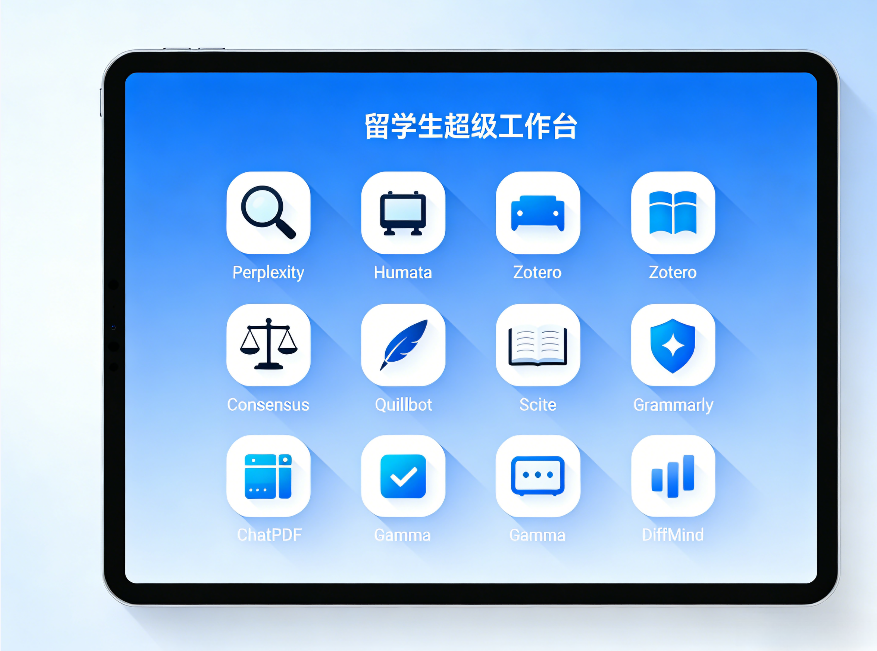
There are countless AI tools on the market. To avoid the situation where "too many tools lead to low efficiency," we will categorize them according to...Real-world operation processWe've selected the Top 10 essential tools. This isn't just a collection of tools, but a comprehensive tactical system.
First Tier: Bridging the Information Gap (Search and Topic Selection)
1. Perplexity: It's a "networked" intelligent brain. When you're clueless about a topic, use it for a broad search; it can provide summaries with real-time sources to help you quickly clarify the current situation.
2. Consensus: It's designed specifically for academic purposes. If you ask, "Do video games affect adolescents' cognition?", it won't give you ambiguous answers, but will directly extract the research conclusions (Yes/No/Maybe) from relevant papers, along with a credibility analysis.
Second tier: Solving the problem of not being able to finish reading (reading and extracting key points)
3. ChatPDF: Tired of reading materials that are dozens of pages long? Just give it the PDF and ask questions like "What is the core argument of this article?" or "What are the methodological flaws?" to increase efficiency tenfold.
4. Humata: An expert in handling long and complex documents. Compared to the former, it performs more stably when handling complex data and cross-page citations, accurately locating the original source and preventing AI from fabricating information.
Third Tier: Saving the Desire to Express Oneself (Writing and Polishing)
5. Quillbot: A must-have tool for international students. Specifically designed to solve the problem of "I want to express A, but it sounds like B" by providing synonym rewriting in various tones, reducing plagiarism rate while improving the naturalness of the writing.
6. Grammarly: It's fundamental, but essential. It not only corrects grammar, but now it can also adjust tone, ensuring your emails don't offend professors and your papers don't contain basic errors.
Fourth Tier: Core Brain (Logic and Integration)
7. DiffMind: This is a powerful tool that many international students overlook. It's not just a simple generator, but your...Logical ArchitectIt is responsible for connecting the fragmented information gathered by the aforementioned tools into a well-structured and meaningful article.
Fifth Tier: Avoiding Academic Misconduct (Citation and Verification)
8. Zotero: The ultimate reference management solution. Works with browser plugins for one-click data capture and automatic generation of reference lists, eliminating the nightmare of manually typing formatting.
9. Scite: Citation Guardian. It can tell you whether the cited literature is supported or refuted by the academic community, preventing you from citing theories that have been refuted and causing your assignment to fail.
Sixth Tier: Group Assignment Savior (Demonstration and Reporting)
10. Gamma: Simply input an outline, and a beautiful PPT will be automatically generated. Group assignment help international students In scenarios where you need to quickly produce a slide that will wow the audience, it is the first choice.
Personal one-stop learning workflow:DiffMind How do I become a "commander"?
Many students have Quillbot, GPT, and Zotero, but their assignments still look like a "Frankenstein's monster." Why? Because they lack a...Unified logical center。
Here we introduce DiffMindThis demonstrates a closed-loop workflow from topic selection to submission:
Phase 1: Raw Material Collection
- use Consensus Find 5-10 core articles.
- 用 ChatPDF Extract the key arguments and data from each document.
Phase Two: DiffMind Core Integration (Key Step)
At this point, if you have a bunch of scattered ideas, piecing them together directly will lead to logical gaps. Open DiffMind:
- Building the skeleton: Feed the abstracts you extract from different documents to DiffMind and instruct it: "Based on these materials, construct a detailed outline of [your topic] that builds upon the existing arguments and demonstrates critical thinking."“
- Complete the logic chain: AI-generated content often lacks depth. Use DiffMind's mind mapping or structured writing features to check the transitions between paragraphs. It can help you identify: "The arguments in the second paragraph do not strongly support the thesis; it is recommended to add [specific data]," thus fixing logical flaws.
- Standardize academic terminology: This is the most crucial point. You can set DiffMind's role as a "rigorous academic researcher." Even if your source materials have vastly different styles, DiffMind can rewrite them into...The same sound(Tone of Voice) makes the entire article appear as if it were written by one person in one go.
Phase Three: Polishing and Compliance
- Put the initial draft generated by DiffMind into Quillbot Make minor adjustments.
- use Zotero Insert precise references.
- Go through it one last time. Turnitin(Or use the school's plagiarism detection system) for self-checking.
Deadline-based self-rescue checklist
Panic won't help when facing deadlines; execution is key. Please save this reverse checklist:
- D-3 Days (Topic Selection and Structure):
- Determine the Topic.
- Five core literature articles were collected.
- output: Use DiffMind to generate detailed outlines with first- and second-level headings.
- Day 2 (Filling in the details and first draft):
- For each point in the Outline, fill in the literature evidence.
- output: A draft that is logically sound, but whose language may not be perfect.
- Day 1 (Polishing and Formatting):
- Unified Tone: Check if it is too colloquial.
- Check the logical chain: Are the paragraph transition words (However, Furthermore) natural?
- output: The Final Draft is cited in the correct format.
- D-Hour (Final Inspection):
- Export to PDF and check the layout.
- Submit the Canvas.
Conclusion
AI isn't meant to make you lazy; it's meant to liberate you from tedious formats and language barriers, allowing you to focus on true critical thinking. Make good use of this... Study tools With a combination of strategies, DiffMind can help you uphold your logical principles, transforming your study abroad experience from "desperately rushing to meet deadlines" to "effortlessly securing an A."