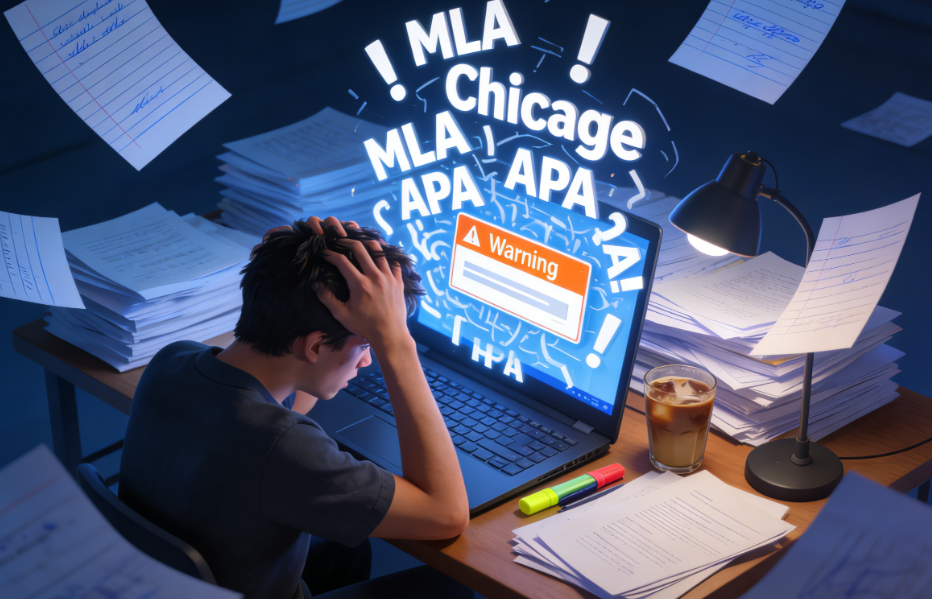
Are you currently in this state: The paper is finally finished, you glance at the time—2 AM. You think that's the end? No, the real "hell mode" has only just begun—Reference List。
Your advisor casually wrote "Use APA 7th Edition" in the syllabus, only to discover that all your previous drafts were written in MLA format. So you begin your tedious, repetitive work:
- Change the author's name from "Smith, John" to "Smith, J.";
- Change the book title from "Title Case" to "Sentence Case";
- Debating whether journal titles should be italicized or not? Should the volume number be followed by a comma or parentheses?
- Do I need to add "Retrieved from" when referencing a webpage?
The most frustrating thing is when you finish revising the 30th reference, you suddenly realize that the format of the 5th reference seems to be wrong again. This kind of moment that drives people crazy because of punctuation, italics, and capitalization is probably the "darkest moment in academia" that every international student has experienced.
Breakdown: Why are your citations always getting penalized?
Often we think "good enough" is fine, but in the rigorous academic world, formatting errors are often seen as a lack of professionalism and can even affect grade assessment. Here are some typical issues that Turnitin and advisors most frequently point out:
- Inconsistency between in-text citations and lists: The text says
(Johnson, 2019)You might scroll to the last Reference List and still not find Johnson anywhere; or Brown's articles might be on the list, but never cited in the text. These "ghost references" are a major area for point deductions. - Number of authors and
et al.Misuse: APA 7 stipulates that if there are 3 or more authors, it must be used.et al.However, MLA 9 may have different regulations. Many students, without considering the specifics, add authors simply because they see two authors.et al.Or, you might write the full name the first time you use it, but forget the abbreviation the second time, leading to chaos. - A "neither fish nor fowl" result from mixing different types: Citing a website as a journal, or an e-book as a physical book, results in missing DOIs, extra URLs, or completely incorrect volume and issue numbers.
- Missing Fields: Citing journal articles without specifying the page range; citing books without specifying the place of publication (although APA 7 no longer requires the place of publication, the Chicago format may still require it). These omissions make citations appear highly unprofessional.
Personal safety net process: A manual self-rescue guide
Before relying entirely on tools, it's recommended to first establish your own "formatting hygiene habits." This process can save you 80% of rework time.
- Step 1: Confirm the "Game Rules"“ Before you start, check the syllabus. Is it APA 7, MLA 9, Chicago, or Harvard? Are there any specific department guidelines? Don't assume anything.
- Step 2: Create a "Source Information Table"“ Don't format as you type. It's recommended to create a table in Excel or Notion with separate columns for the records.Author / Year / Title / Source (Journal Name/Publisher) / DOI or URLIf the original information is accurate, the subsequent generation will not be wrong.
- Step 3: Batch generation and initial screening After generating the initial draft using Citation Generator, manual "alignment" is performed. This ensures that all entries are correctly ordered (alphabetical order) and that sources of the same type have the same format.
- Step 4: Reference Coverage Check Finally, after reading the entire text, ask yourself: Does every non-original claim/data point have parentheses after it?
Advanced solution: Use DiffMind Achieve automated proofreading and generation
Manually formatting can indeed be a good way to relax, but if you want to sleep an extra two hours before the deadline...DiffMind Such AI-powered academic aids can help you achieve a "leapfrog development." It's not just a generator, it's your... Citation Proofreading expert.
- One-click switching of reference systems (Format Switching): Regardless of the format you used to take notes, DiffMind supports one-click conversion between mainstream formats such as APA, MLA, Chicago, and Harvard. It automatically adjusts author abbreviations, date positions, and title capitalization, saving you the pain of manually changing commas one by one.
- Full text scan: Gap detection: This is its most powerful feature. DiffMind can scan your entire text and automatically compare in-text citations and reference lists.
- alarm: “"in the main text"
(Lee, 2021)Not found in the reference list.” - alarm: “"Smith's article in the reference list is not cited in the text." This helps you completely eliminate "ghost citations."
- alarm: “"in the main text"
- Detail Unification: It uses a database to check metadata. For example, if you enter a journal name in abbreviation, it can automatically complete it to the full name according to the format requirements; or it can automatically detect missing DOIs and attempt to complete them. It can also uniformly handle italics and punctuation, ensuring that your bibliography looks as neat as printed material.
Self-Help Checklist: The Last Line of Defense Before Submission
- System verification: Confirm that the current format version (e.g., APA 7th) meets the job requirements.
- Cross-check: Every item cited in the main text is in the list, and every item in the list is in the main text.
- Correctly sorted: They are usually sorted alphabetically by the last name of the author, A, Z.
- All fields are complete: Check if page numbers, years, or DOIs are missing.
- Missing quotation marks: All data, quotations, and rewritten viewpoints have been properly attributed.
- Standard format: Check whether italics and hanging indents have been processed uniformly by DiffMind.
Conclusion: The core of academic writing lies in the viewpoint; don't let tedious citation formats waste your precious brainpower. Master the correct process and make good use of DiffMind for automated proofreading. You'll not only free yourself from tedious formatting adjustments but also demonstrate rigorous and professional academic competence to your tutor. Go to bed early tonight!