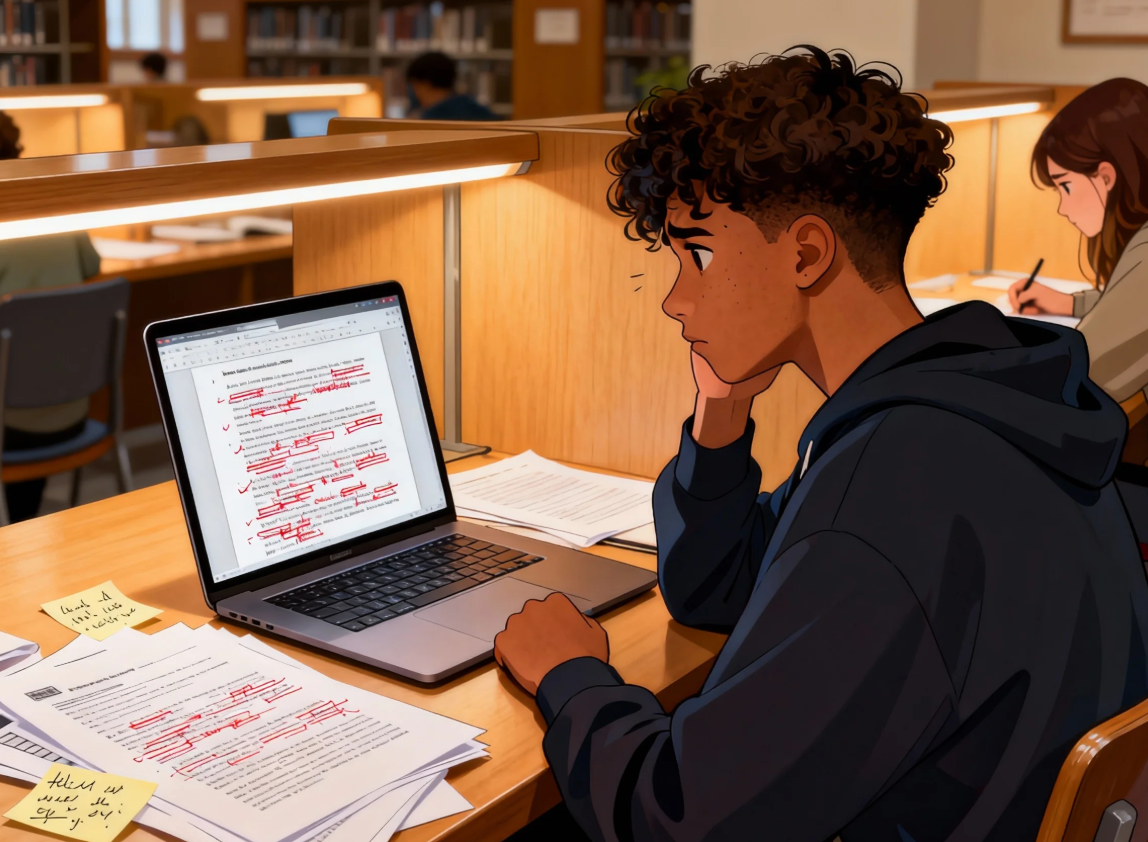
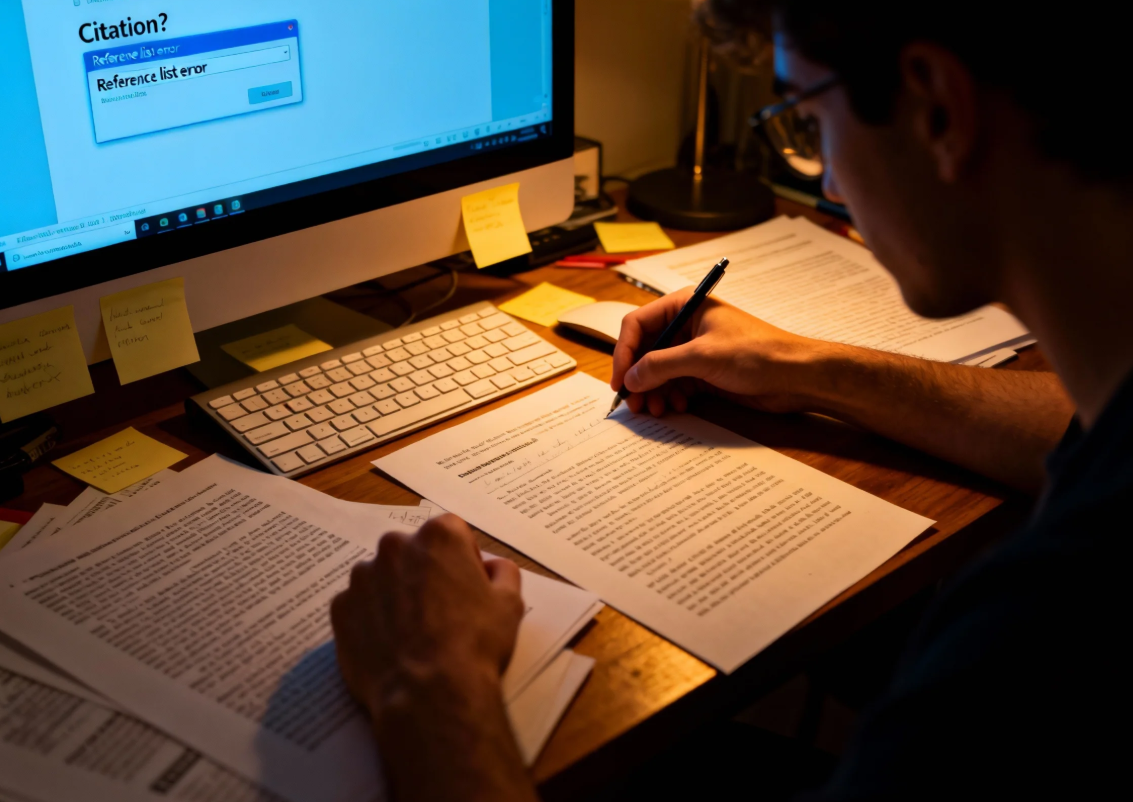
1) Real pain point: I know I need to cite it, but I just don't know where to insert it.
Many people don't lack the desire for standardization, but rather get stuck in these typical scenarios:
- Halfway through writing, a "fact/figure/conclusion" suddenly appeared.“I'm afraid of being accused of plagiarism if I don't cite it, but if I do, I don't know whether to put it at the end of a sentence or a paragraph.
- The passage mixes "my opinion" with "other people's opinions".“I don't know which sentences the quote actually covers.
- The number of references is increasing.The citations in the main text and the references at the end do not match, and the format is not consistent (APA, MLA, and Chicago are mixed together).
- The citation order is completely messed up after the revision.: A section was deleted, but there is still a "ghost reference" in the text; or there is an entry in the references that has never been cited in the text.
To solve the problem of "not being able to insert," the key is not to memorize the format, but to first figure out: **Does this sentence borrow someone else's intellectual property?** If so, the "scope of borrowing" and "source of borrowing" must be clearly indicated.
2) The role of citations in academic papers: more than just "avoiding plagiarism"“
Citations (in-text citations) serve at least four functions in a paper:
- Prove that your argument is supported by evidence.Let the readers know that you are not just guessing.
- Define the boundaries of intellectual property rightsWhich of these are existing studies, and which are your contributions?
- Make the argument traceableReaders can verify the data, methods, and conclusions by following the source.
- Improve credibility and publishabilityStandard formatting and accurate citations are the basic "threshold requirements" for academic writing.
Simply put: Citation is an "evidence label," and Reference is an "evidence list." The two must correspond one-to-one and be consistent in style.
3) Common insertion locations for citations: You can check them directly.
The following are the places where you are most likely to "necessarily omit a citation". You can use this as a citation insertion checklist (the core method for judging how to add citations correctly).
A. Any verifiable facts/figures/statistics“
- Example: Incidence rate, market size, growth rate, and experimental results of a certain disease.
- rule:Numbers, proportions, years, rankingsYou should generally cite the source (unless it is your own original experimental/survey data).
B. Any "background knowledge that is not common sense"“
- Example: the definition of a theory, the explanation of a mechanism, the key content of a policy provision.
- Rule: If not every reader knows the information, and you did not originally propose it, you need to provide a citation.
C. Borrowing others' viewpoints, conclusions, or points of contention (even if you rewrite them in your own words).
- rule:Rewriting does not mean not using references.Any idea or argument that comes from someone else should be cited.
D. Using other people's methods, models, scales, questionnaires, and algorithmic frameworks.
- Example: A classic model, source of scale items, and experimental procedure reference.
- Rule: Method class references usually appear in the "Method/Methods" section and often need to be accurate to the specific version or author year.
E. Comparison and Induction in Related Work/Literature Review
- Rule: Review paragraphs often contain phrases like "multiple studies support a single conclusion," which can be used to:
- 在Conclusion sentence endGroup citations together; or
- Place the corresponding citation after each clause (for greater precision).
F. Quoting the original sentence (direct quotation)
- Rules: Quotation marks must be used (or handled according to subject-specific norms), and page/paragraph numbers must be indicated as required (depending on the format).
4) Why you feel like you "can't get in": 3 common obstacles
- I'm unsure which section the citation should cover.
- Solution: Ask yourself this question – "If I remove the citation from this sentence, will it make me seem like I'm impersonating someone else as my discovery?"“
- Citation too late or too early
- Too late to the quote: Readers don't know which preceding sentence is the source's viewpoint.
- Too early: the reader assumes all subsequent sentences come from the same source.
- The root cause of the reference disorder is "incomplete metadata".“
- Missing fields such as author, year, journal name, volume, issue, page, publisher, DOI/ISBN, etc., will cause the format to be incorrect.
5) DiffMind How can I help you: Solve everything from "where to plug" to "unified style" in one go.
5.1 Helps determine citation location (solves the problem of "citation not being inserted")
The value of DiffMind lies not in "forcing" citations onto you, but in helping you semantically break down the main text:
- Mark Factual statements/data sentences/others' conclusions/method sources/your original viewpoints boundary
- Provide hints for "high-risk sentences" (sentences most likely to require quotations).
- The more appropriate placement is suggested: "at the end of the sentence, at the end of the paragraph, or at the beginning of the method paragraph?"
This way you won't get bogged down in the dilemma of "which article should I quote in this paragraph?"
5.2 Unified Citation Style (APA / MLA)
When importing literature from different sources, the most common problem is that the same document appears in multiple versions (different author abbreviations, different capitalization of the title, different journal name abbreviations). DiffMind can help:
- Pair in-text citations with reference entries.
- Standardize the output field order, punctuation, and capitalization rules according to the specified style (APA or MLA).
- Avoid the problem of "the body text is APA, but the ending is MLA".
5.3 Reduce Ref errors (mismatches, missing fields, duplicate entries)
DiffMind can help you reduce these types of "simplistic but fatal" mistakes:
- The text contains citations, but the references are missing entries.(Omitted)
- There are reference entries, but no citations in the main text.(Ghost Documents)
- The same document appears twice(Repeated reference)
- Author-year discrepancy(Incorrect year or mixed versions)
6) Practical workflow: A set of methods that can be directly followed (including DiffMind)
The following process is suitable for papers, course papers, English writing, or research reports. The goal is:First, determine the correct "insert location," then standardize the "format."。
Step 1: First, bold the main text according to the "Information Type".
After writing a paragraph, check it yourself in the simplest way:
- This is My opinion/reasoning Okay?
- This is Others' conclusions/data/definitions Okay?
- This is Source of methods or tools Okay?
Unless it is purely original reasoning, mark it with a "to be cited" tag (e.g., [CITE]).
Step 2: Use DiffMind to scan the "sentence to be quoted" to determine the insertion position.
Submit the paragraph containing "CITE" to DiffMind:
- Let it suggest "more appropriate citation placement points" (end of sentence/end of clause/end of paragraph).
- Let it indicate whether "this statement is common sense" or "it sounds more like an assertion that needs to be supported by evidence."“
You can make the final decision then:To quote or not to quote。
Step 3: Associate each citation with a specific source.
in principle:A key assertion should ideally correspond to its most direct source.。
- Data should prioritize original data/authoritative reports.
- The viewpoint should be cited first or as the most classic one.
- Reviews can cite high-quality reviews, but don't use reviews to replace all original evidence (unless the discipline allows it).
Step 4: Select a consistent format (APA or MLA), and do not change it midway.
- Common APAs in academic papers, psychology, and education
- MLA is commonly found in literature and humanities.
Use DiffMind to set the output style once, avoiding the need to manually change punctuation or author order.
Step 5: After generating the reference, perform a "three-way comparison check" (most crucial).
Before submitting, check using DiffMind or your own checklist:
- Each citation in the text can be found in the References section.
- Each reference is cited at least once in the text.
- The author-year (or author-page number) should match the text.
Step 6: Run the draft again after revision (to avoid "messing up after revisions")
After deleting paragraphs, changing sentences, or merging paragraphs, citations can easily "drift".
Recommendation: After each major revision, redo the pairings and style consistency using DiffMind to avoid making mistakes while working through the night on the last day.
7) Quick check: When is it easiest to miss a citation?
- You wrote "Research shows/Data shows/Some scholars believe" but didn't say who.
- You provided specific numbers but no source.
- You rewrote the logical structure of someone else's paper, thinking, "If I didn't copy the sentences, I don't need to cite them."“
- You pieced together a paragraph from multiple articles, but ultimately only quoted one.
Treat these as your citation red flags, and you can significantly reduce confusion between citations and references.
Conclusion
“The issue of "citations not being inserted" is not essentially a formatting problem, but rather...Unclear reference boundariesThe essence of "references being completely messed up" is not that you're not trying, but rather...Inconsistency check between in-text citations and end-of-text entriesWith clear insertion position rules, consistent output style, and cross-checking, you can truly master how to add citations correctly. DiffMind's role is to transform this process from "manual memorization + repeated rework" into a "verifiable, reusable, and one-click unified" workflow.