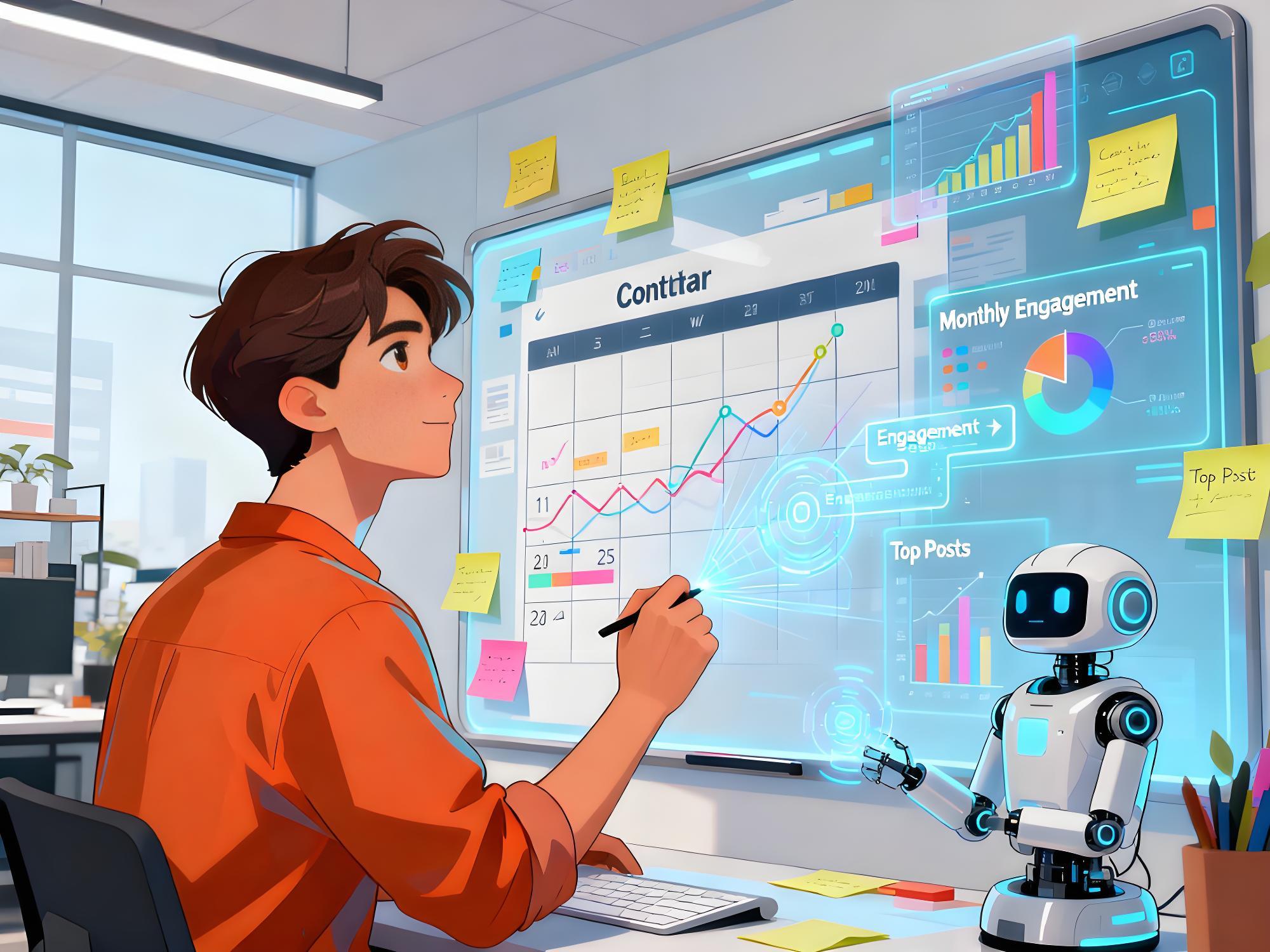

As content creators, what we fear most is not "writing articles," but "not knowing what to write."
We constantly oscillate between "chasing trending topics" and "waiting for inspiration." When inspiration strikes, we can come up with three ideas a day; when inspiration fails, we can sit in front of a blank document for an entire afternoon.
We appear to be posting daily, but in reality, we have no plan whatsoever. The pace of our content is completely dictated by algorithms and data; if one post goes viral, we quickly copy the next; if one flops, we quickly switch tracks.
This kind of "guerrilla warfare" style of creation not only leaves us physically and mentally exhausted, but also prevents us from forming our own unique content barriers.
The "systemic" pain points of creators
Are you also stuck in these three "vicious cycles"?
- Unable to grasp the inspiration for a topic: Inspiration is always "scattered". A brilliant idea flashes by while you're showering or on the subway, but by the time you open your notes app, it's already "gone". You may have saved 1000+ resources, but when you need them, you can't remember a single one.
- Content scheduling is chaotic: “The "schedule" is entirely based on intuition. This week, it's "prolific like a sow," next week it's "absent like a ghost." The content lacks "rhythm," not knowing when to post "valuable content" to attract traffic and when to post "daily content" to retain followers, it all depends on "what I want to post today."
- The review was unsystematic and relied on "mystical" methods for its content. A video goes viral, and you "feel" it's because the background music was great; a video flops, and you "feel" it's because the title was wrong. The review relies entirely on "gut feeling," without data to support it, and you don't know how to "iterate." Whether the next piece of content will be good or bad depends entirely on "opening a blind box."
DiffMindThe "satisfaction point": Your "AI editor-in-chief"“
We use GPT-5 This AI is like a "writer". But DiffMind This kind of "multi-model AI comparison workbench" is more like a "“AI Editor-in-Chief”It not only helps you "write", but also helps you "plan" and "review".
You throw your requirements in.GPT-5, Claude 4.5, Gemini 2.5 Pro It will "simulate" the screen to develop strategies for you.
- Feature 1: One-click generation of a "topic selection matrix"“ You're no longer just "picking up" inspiration, you're "producing" it. Give DiffMind a keyword, and it will instantly provide you with a "content matrix" of 50 topics across four dimensions: "user pain points," "industry trends," "controversial topics," and "practical tutorials."
- Second highlight: Automatic suggestion of "content pacing"“ DiffMind can automatically suggest "prime times" for your content based on your field (e.g., "beauty" vs. "technology"). For example: Monday (in-depth content), Wednesday (product reviews), Friday (trending topics).
- Feature 3: Automatically generates "debriefing reports"“ This is amazing! You just throw in the "data" and "comments," and DiffMind can automatically analyze them for you:Highlights(Which "golden quote" was screenshotted the most?)question(At which second is the bounce rate highest?)Next iteration point(Should we optimize the first 3 seconds, or change the cover?)
- Point 4: Compare multiple versions for quick focus For a given topic, GPT-5, Claude 4.5, and Gemini 2.5 Pro will offer completely different "entry points." You no longer need to "struggle"; you only need to "compare" and "select."
Practical Tips: Three Steps to Build an "Automated" Content System
Let's get down to business. Let's say you're a "career blogger":
Tip 1: Generate an "infinite" number of topics (topic matrix) using a single sentence.
Scene: You want to work on the topic of "interview skills," but you're worried it'll be too old-fashioned.
[Efficient Prompt Example]
“"I'm a career blogger, and my main topic is [interview skills]. Please have all the AIs (in DiffMind) help me generate a 'topic selection matrix,' with the following requirements:"
- Horizontal axis (user): Targeting recent graduates vs. experienced professionals.
- Vertical axis (content): [Avoiding Pitfalls Guide] vs. [Advanced Conversation Techniques].
- Five "viral" topics will be generated in each quadrant.“
(You will receive): 20 precise and well-categorized topics. For example, [Recent Graduates x Avoiding Pitfalls] = "5 'Polite' Phrases You Should Never Say During an Interview".
Tip 2: Use the "topic selection bank" to automatically generate a "schedule".“
Scene: You just received 20 topics and don't know how to publish them.
[Efficient Prompt Example]
“"I'm a career blogger, and here are my 20 topics for the next month [paste your topics]. I'll be posting four times a week (Monday, Wednesday, Friday, and Sunday)."
Please have all the AIs (in DiffMind) help me create a 4-week content release schedule. Requirements:
- Monday/Wednesday: Post content related to 'useful tips/avoiding pitfalls'.
- Friday/Sunday: Publish 'Advanced/Trending' content.
- Present it in tabular form.”
(You will receive): An Excel-style scheduling table with clear logic and a well-defined schedule.
Tip 3: Use "data" to generate "debriefing summaries" in batches“
Scene: Your video from last week, "5 'Polite' Phrases You Should Never Say During an Interview," had mediocre results.
[Efficient Prompt Example]
“"I need to do a content review." theme: Five polite phrases you should never say during an interview. data: With 10,000 views and a completion rate of 30%, the comments section reflected: "I understand the logic, but it's not dramatic enough" and "The first 10 seconds were too bland." Target: The next video is aiming for 100,000 views.
Please have all the AIs (in DiffMind) help me analyze:
- What are the core issues?
- What highlights should be retained?
- What are three specific suggestions for the next iteration (introduction, script, cover)?”
(You will receive): GPT-5 might suggest starting with a rhetorical question, while Claude 4.5 might suggest adding a real-world failure example. Combining these approaches will give you the "optimal solution."
Summary: From "Content Guerrilla" to "Content Regular Army"“
Let's say goodbye to creating content based on gut feeling.
Using multi-model AI tools like DiffMind is not about "taking shortcuts," but about building a "sustainable" system:
- Using a "topic selection matrix"“It transforms you from "waiting for inspiration" to "managing inspiration."
- Use "intelligent scheduling"“It transforms you from being "held hostage by algorithms" to "leading user expectations."
- Use "automatic review"“This allows you to form a "data-driven" "closed loop," ensuring that each output is stronger than the last.
This is what constitutes a content creator's "moat."