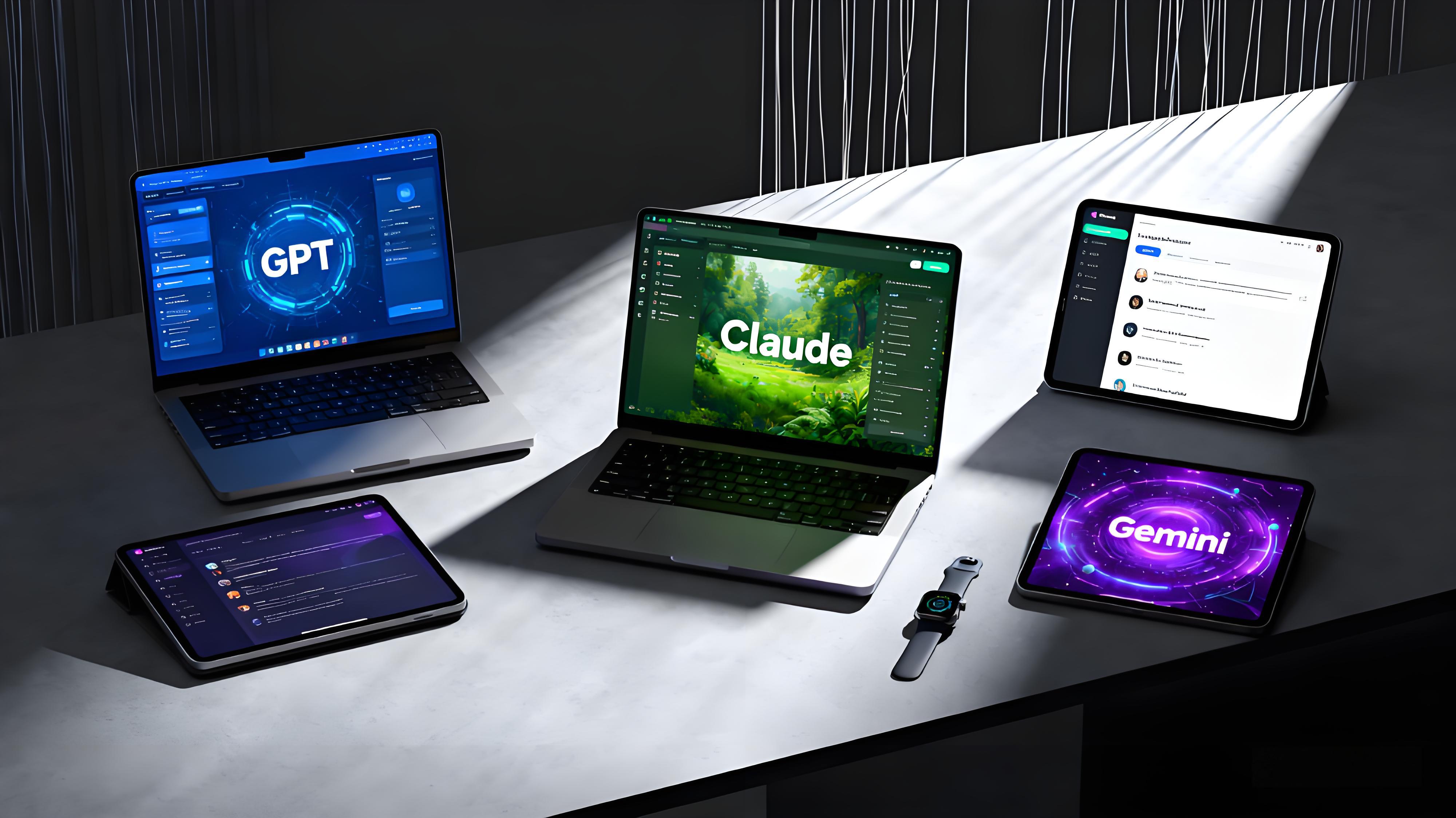

Last week, I helped a friend who was studying abroad revise his paper. He used GPT and Claude to write the same section, and the conclusions were completely opposite: GPT said "this application is not realistic," while Claude cited three success stories and said "it has great potential." I was stunned: they're both AI, how can the answers be so different?
Later, I used DiffMind to input the problem, and GPT, Claude, and Gemini all provided answers simultaneously. That's when I realized—The difference in AI is not about "who is right and who is wrong," but rather that "they inherently have different 'personalities' and 'areas of expertise'."“。
I. The "Different" Aspect of AI Lies in its "Training Genes"
You can think of different AIs as "people with different professional backgrounds":
- GPTLike a "rigorous STEM professor": He speaks with clear logic and likes to use data and frameworks, such as dividing his papers into "first, second, and last" sections, but he is a bit clumsy when it comes to "emotional expression".
- ClaudeLike "warm-hearted humanist writers": they are good at storytelling and can extract warmth from details. For example, when writing copy, they will use metaphors such as "the flowers by the roadside do not bloom earlier than anyone else", but they can be a bit roundabout when talking about technical details;
- GeminiLike "lively internet youth": they like to use memes and speak with a bit of "internet savvy". For example, when writing short video scripts, they will use interactions such as "@you_curious_classmate", but they don't quite understand "academic rigor".
Their "differences" are essentially determined by the "corpus and algorithm" used during training: GPT read the most academic papers, Claude understands "emotional communication" better, and Gemini learned the most "memes" from small video platforms.
II. Real-world example: Three AIs providing "different answers" to the same question.“
To clearly see the differences, I chose a common question:“"Write a 30-second TikTok script for college students on 'Rejecting Involution,' which should be interesting, relatable, and shareable."‘
- GPT's answer(Logic-oriented):
“"Opening: 'Feeling overwhelmed by the pressure every day? Getting pressured to study early in the morning, staying up late to finish assignments, even eating quickly gets you pressured?' Middle: 'Stop the pressure! You're not the king of pressure, you're the protagonist of your own story—go to the playground to soak up the sun, go to the library to read a book, life isn't just about the pressure of competition.' Ending: '@Your friend who always complains "I can't keep up the pressure," let's 'win without lifting a finger' together!'"‘
Advantages: Clear logic and sound values; Disadvantages: Too preachy, lacks internet savvy, young people may find it "too serious". - Claude's answer(Emotionally-oriented):
“"Opening: 'Have you noticed that roadside flowers never bloom earlier than anyone else? They simply bloom at their own pace, in their own season.' Middle: 'We're the same; we don't need to chase after others—your 'slowness' might be a unique sight.' Ending: 'Forward this to your most 'slow' friend and tell them: your 'flowering season' is up to you.'"‘
Advantages: Strong emotional resonance and vivid imagery; Disadvantages: Weak dissemination and guidance; young people may be moved but not share it. - Gemini's answer(Focusing on memes):
“"Opening: 'Family, does anyone understand?! Your 'exhaustion king' deskmate is at it again, saying 'Ah~ I studied until 3 AM last night' while you're memorizing.' Your 'exhaustion king' roommate is at it again, saying 'Ugh~ I'll just do a quick one' while you're rushing to finish your PPT!' Middle: 'Don't fall for PUA! Your time isn't 'exhausted,' it's 'spent'—play games, binge-watch dramas, daydream. Your 'laissez-faire' attitude is the coolest counterattack!' Ending: 'Dare to tag your 'exhaustion king' deskmate? Let them see the daily life of the 'anti-exhaustion champion'!'"‘
Advantages: Strong online appeal and high interactivity; Disadvantages: The logic is a bit illogical, and the "give up" value system may not be accepted by everyone.
III. Why are "different answers" more important?
If you only choose one AI answer, you might encounter some pitfalls:
- I chose the "lecture-style" version of GPT, but nobody watches the videos.
- I chose Claude's "emotional version," but no one shared it.
- Choosing the "meme-filled version" of Gemini is controversial in terms of its values.
But if we combine the three answers:
- By using GPT's logical framework (pointing out the pain point of "rolling" at the beginning) + Claude's emotional resonance ("flowers bloom at their own pace") + Gemini's interactive guidance ("@rollingking's deskmate"), you can write a script that is "witty, opinionated, and shareable" - this is the value of "multi-perspective integration".
Four,DiffMindIt allows you to "have multiple AI assistants at the same time".“
Previously, when I revised my papers, I had to switch back and forth between GPT, Claude, and Gemini. Now, with DiffMind, I can see the answers from three AIs in one window and directly compare them to see "where the jokes are, where the logic is, and where the data is."
As Leo Park said, "It's not about being faster, it's about 'opening up the horizons'." Before, I only saw the "limitations of a single AI". Now, with DiffMind, I can find blind spots in the "personalities" of different AIs, such as papers lacking case studies, solutions failing to be disseminated, and scripts lacking interaction. These are all hidden in the "differences in AI answers".
V. Conclusion: AI's "difference" lies in giving you the opportunity for "multi-perspective judgment".
The reason why AI's answers "don't match" is because they have different "training genes": some are good at logic, some are good at emotion, and some are good at communication. The truly smart way to use them is to let these AIs with "different personalities" work together for you—you don't need to understand the technology or remember "which AI is good at what," just ask your questions, and let DiffMind help you "compare, filter, and piece together the answers."
Next time you use AI, don't rush to "choose one and use it." Try it. DiffMindLet "thinkers" of different styles work for you in one interface, and you'll discover that the "more comprehensive answer" was already hidden in the "difference".