I. The most common "stumbling blocks" in the thesis proposal can actually be categorized into four types.
- The topic is too broad.It seems grand, but it doesn't come down to specific problems and data.
- Unstable frameworkThe chapters are like a table of contents, not like a chain of arguments.
- The method is not suitableThe problem is cause and effect, but you only provide descriptions; or you want to establish mechanisms, but you lack data.
- Innovation PointsIt only says "fill in the blanks", but doesn't explain "which blank to fill in or how to fill it in".
DiffMind's advantage is that it turns these four types of bottlenecks into a "parallel review" process, allowing six AIs to play different roles at the same time to find faults and improve solutions.
II. Practical Exercise: Using DiffMind Align "Topic-Problem-Method-Data" in one step.“
Assuming your general direction is:“The impact of short videos on consumer decision-making”(You can replace it with your direction).
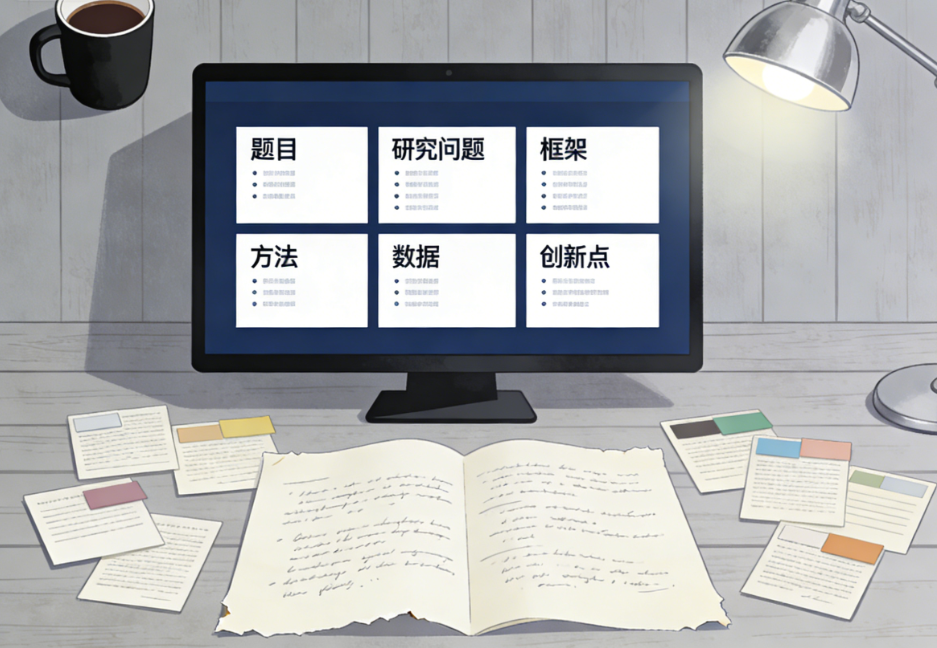
Step 1: Have 6 AIs each play a different mentor/judge perspective. I suggest you divide the tasks like this (same-screen comparison is crucial):
- Topic Selection Convergence Officer: narrow down the general direction into 3-5 workable problems.
- Theoretical Framework OfficerDefine concepts, establish relationships between variables, and establish chains of assumptions.
- Method Design OfficerMatch the question type (description/relevance/causation/mechanism).
- Data feasibility officerWhat data can you obtain? How will you collect it? Sample size? Ethical considerations?
- Innovation Point Reviewers: We'll help you write your innovative points as "specific contributions".
- The defense was tricky, and the judges were very demanding.Here are 15 questions that are most likely to stump you.
General prompt template (can be copied directly)
I'm writing the proposal for my thesis on a specific subject/specialization, and the main theme is a brief overview of that topic.
Please output the following in your role: [e.g., "Method Designer"]:
1) Provide 3 more focused topic options (including keywords);
2) Corresponding research questions RQ1-RQ3;
3) Suggested methodologies (quantitative/qualitative/experimental/case study/mixed approaches) and core variables;
4) Risks related to data sources and feasibility;
5) Expected contributions (at least 2, be specific).
Output should be itemized to avoid empty talk.
Third, when comparing images side-by-side, keep an eye on these 5 "alignment points".“
- Can the question be explained in one sentence?(Object, Context, Variable, Result)
- Can the research question be falsified/verified?(Not a slogan)
- Does the method answer the question?(Don't just describe cause and effect issues)
- Is the data available?(Collection cost, access permissions, sample size, ethics)
- Is the innovation concrete?(New data/new methods/new scenarios/new mechanisms/new indicators)
Mark the differences between the 6 AIs: the greater the difference, the more ambiguous your original settings are, and the more you need to add boundary conditions.
IV. Quickly produce a one-page thesis proposal that you can discuss with your advisor.
Combine the results displayed on the same screen into the following structure (it is recommended that you make it into a single page):
- Questions (1-2 candidates)
- Research Background (3 sentences: Importance + Gap + Your Entry Point)
- Research questions RQ1-RQ3
- Theoretical framework (variable relationship diagram/hypotheses)
- Methods and Data (Sample, Measurement, Identification Strategy/Interview Outline)
- Expected contributions (2-3 specific contributions)
- Risks and Alternatives (Plan B)
You'll find that starting a thesis is no longer about "writing a lot of words," but about "aligning the key points."
V. Conclusion: The opening statement is not a writing battle, but a battle of alignment.
Use DiffMind to have six AIs review your research proposal in parallel: one helps you converge, another helps you find errors, and another helps you supplement the methodology and data. All you have to do is find the contradictions in the differences on the screen and change them into clearer boundaries and assumptions. The research proposal will naturally no longer be a problem.