
1) Why do you feel "at a loss" when it comes to case studies?
Many international students don't struggle with writing case studies because they can't write in English, but because they get stuck on the "analysis path":
- There's too much information; I don't know which ones are important.The case study included market data, financial indicators, interviews, and background descriptions, making it feel chaotic and difficult to grasp the main theme.
- If the problem is not clear, the analysis will go astray.The question asked "Why are sales declining?", but you wrote "How to upgrade the brand?"; teachers often deduct points for "not answering the question".
- Opinions without evidence.The article stated "prices should be raised/lowered, and digital marketing should be implemented," but lacked supporting data and a reasoning process.
- I suggest something like a "common sense medley".“The suggestions are impractical, lack priority, and are devoid of risk and resource constraints, making them read like generic business platitudes.
- Structural chaosThe lack of a framework leads to paragraphs being written haphazardly, making it difficult to conclude in the end.
The solution is simple: treat Case Study as a "reusable decision-making process"—first define the problem, then validate it using a framework, and finally output actionable recommendations.
2) Standard analytical framework for case studies (from "topic" to "conclusion")
If you want to master systematically How to analyze a case studyYou can break down the analysis into 6 fixed modules. If you follow these modules in order each time you write, you're less likely to get stuck.
Module A: Task Clarification
- What exactly do your teacher/company want you to answer?
- What are the output formats: reports, presentations, memos, oral presentations?
- What are the evaluation criteria: growth, profit, risk, compliance, and brand?
Define your goal in one sentence:“"Under the constraints of X, achieve the Y metric and verify it using the Z method."”
Module B: Extracting the Current Situation and Key Facts (Facts & Context)
Organize the information in two layers:
- Hard factsTime, product, price, channel, user, region, financial data, and operational metrics.
- ConstraintsBudget, manpower, regulations, supply chain, technological capabilities, and time window.
Output suggestion: Use 5-10 bullet points as a "fact base" to avoid simply repeating the case study in the entire text.
Module C: Define the core problem
Use the structure "Phenomenon → Impact → Root Cause Hypothesis" to write it:
- Phenomenon: What happened?
- Impact: What is the impact on profits/market share/user retention?
- Root cause hypothesis: What are the possible causes? List 3-5 first.
Module D: Establishing the Analysis Framework
Choose common frameworks based on question type; you don't need to use them all every time.
- Market/Strategy3C, SWOT, PESTEL, Porter's Five Forces
- Growth/ProductAARRR (Advanced Averaging & Retention), 4P/7P, User Journey, Retention Analysis
- Operations/Supply ChainProcess bottlenecks, cost structure, quality and delivery
- financeProfit breakdown (Revenue = Quantity × Price; Profit = Revenue - Cost), unit economic model, sensitivity analysis
- Organization/ManagementIncentive mechanisms, organizational structure, and resistance to change.
The key is not the "frame name", but answering with a frame:What is the problem, what is the evidence, and what are the priorities?。
Module E: Validation and Comparison (Evidence & Tests)
Turn "guessing" into "verifiable":
- What data is needed to validate each hypothesis?
- Benchmarking: How does it compare to historical benchmarks, competitors, and industry averages?
- If data is missing: This indicates the assumptions and the data that needs to be added in the next step.
Module F: Conclusion & Recommendations
It is recommended that the following four attributes be present:
- symptomatic treatmentOne-to-one correspondence between core issues/root causes
- LandableWho does it, what does it, and when does it?
- MeasurableIndicators and target values
- Controllable risksRisks, costs, and alternative solutions
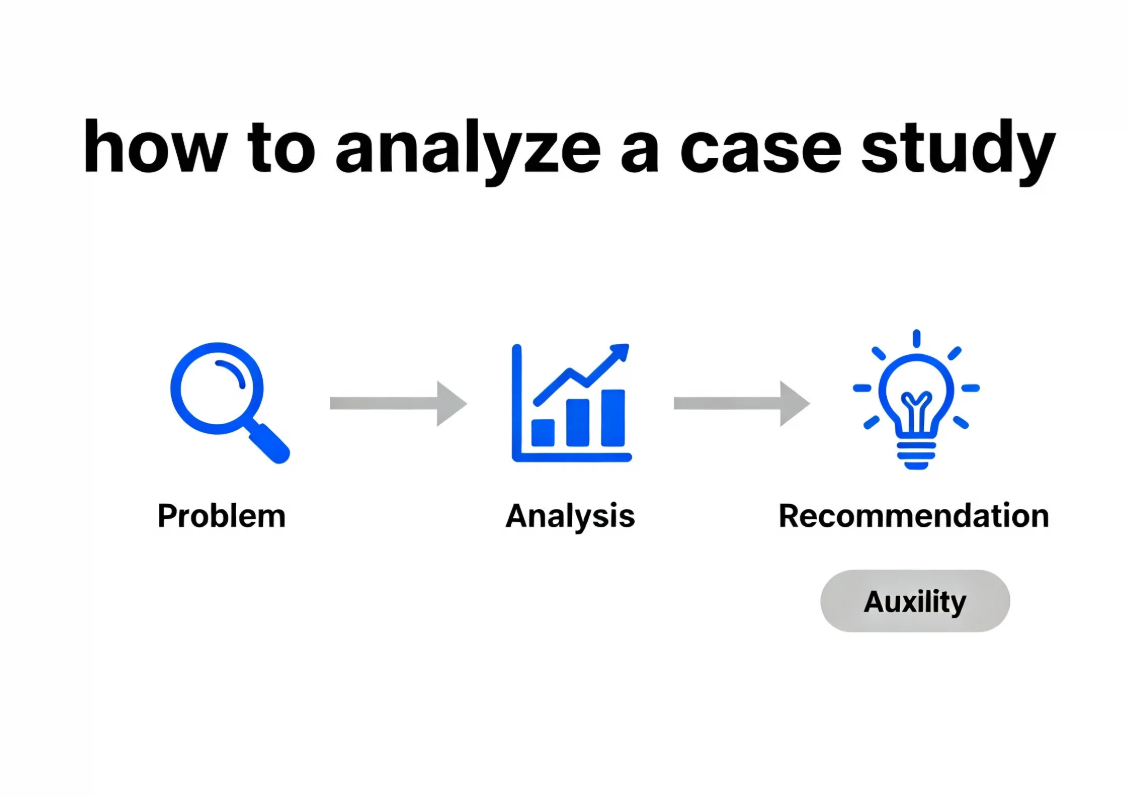
3) General "Problem → Analysis → Suggestion" path (follow this path directly when writing)
Below is a reliable output order that is suitable for most courses and business cases.
Step 1: The Problem
Write down three things clearly:
- TargetWhat needs improvement? (Profit/Growth/Retention/Efficiency/Satisfaction)
- gapHow much difference is there between the current situation and the target?
- scopeWhat is the business/region/product/time range?
Example sentence structure:
This case requires restoring the monthly sales volume of product A in market B from X to Y within 6 months, while maintaining a gross profit margin no lower than Z.
Step 2: Analysis
The suggested approach is "disassembly + evidence + prioritization":
- DisassemblyBreak down a large problem into 3-5 sub-problems (e.g., demand, supply, price, channels, marketing, product experience).
- evidenceEach sub-problem should be supported by at least one piece of data or fact.
- SortPrioritize based on impact × feasibility (address the biggest leverage point first).
Step 3: Recommendations
Use "three-level output" to make your answers resemble high-scoring assignments/consulting reports:
- Main recommendations (1–3)The most crucial action
- Implementation plan (30/60/90 days or phase milestones)
- Indicators and RisksKPIs, budget, manpower, dependencies, potential side effects and solutions
4) DiffMind How to help you "break down case studies + analyze from multiple perspectives"“
When you're stuck because you "lack a path" and "lack a perspective," DiffMind's value lies primarily in two aspects:
4.1 Helping to break down case studies: From materials to structured output
- Quickly extract key informationCompress long case studies into a list of key points: "Background - Problem - Data - Limitations - Objective".
- Automatically generate problem tree/hypothesis listBreak down a major problem like "declining sales" into analyzable branches (product, price, channel, competitors, users, macro factors, etc.).
- Turn the framework into a fillable outlineInstead of starting with a blank page, you begin writing with a "fillable structure".
4.2 Multiple models provide different analytical perspectives: avoiding a singular approach
- Strategic perspectiveExplain "why" from the perspectives of industry, competitive landscape, positioning, and competitive advantage.
- Data/Financial PerspectiveQuantify the problem and use profit breakdown, unit economic model, and sensitivity analysis to find key variables.
- User/Product PerspectiveFind growth levers from the user journey, conversion funnel, retention and experience.
- Operational Implementation Perspective: Starting from resources, processes, organization, and risks, make the recommendations more actionable.
You can think of it as "multiple teaching assistants helping you review the question and fill in the gaps in your knowledge," and ultimately you make the choices and integrate them to form a more complete and defensible chain of conclusions.
5) One-page Case Study template (can be copied and used directly)
The template below can be used directly as the framework for your assignments and is suitable for most courses.
[Case Study Template]
1. Executive Summary (3–5 sentences)
- Background in one sentence:
- The core issue can be summarized in one sentence:
- Key findings (2–3):
- Key recommendations (1–3):
- Expected results (indicators):
2. Background & Facts (Key Points Listed)
- Company/Product/Market:
- Timeframe and objectives:
- Data summary (sales volume, profit, market share, retention, etc.):
- Key constraints (budget/regulations/capacity/time):
3. Problem Statement
- Phenomenon:
- Influence:
- Success criteria (KPIs):
4. Hypotheses
H1:
Evidence/Required Data:
H2:
Evidence/Required Data:
H3:
Evidence/Required Data:
5. Analysis (Expanded by framework)
- Framework selection: 3C / SWOT / Funnel / Profit breakdown / Five forces / Other
- Sub-problem 1 (Conclusion + Evidence):
- Sub-problem 2 (Conclusion + Evidence):
- Sub-problem 3 (Conclusion + Evidence):
- Prioritization criteria: Impact × Feasibility
6. Recommendations and Implementation
- Suggestion 1: What to do + Why + How to do it
- Person in charge/resources:
- schedule:
- KPI:
- Risks and Countermeasures:
- Recommendation 2:
- Recommendation 3:
7. Next Steps & Data Needed
- Gap data:
- Validation methods (experiment/survey/benchmarking):
- Decision-making milestones and timing:
Conclusion: Transform "writing a case study" into "going through the process"“
Once you master the fixed path of "clarifying the task → extracting facts → defining the problem → framework analysis → evidence verification → implementation of recommendations," case studies are no longer about inspiration, but a process-oriented task. By using DiffMind's decomposition capabilities and multi-model perspectives to fill in any gaps in your thinking, you'll be able to quickly form a clear chain of arguments and write structured reports that resemble high-scoring answers.