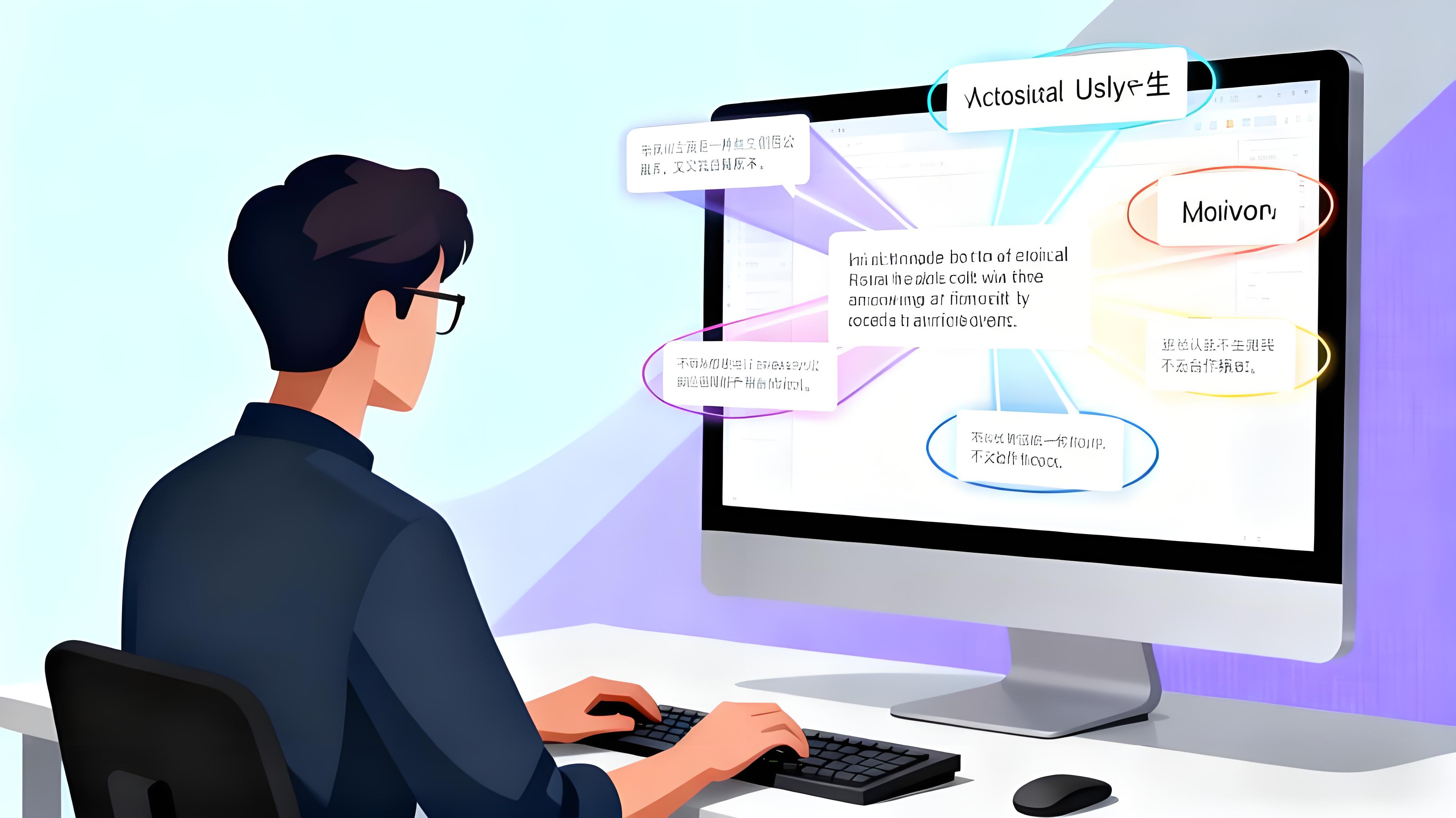

Last week, I helped a student revise her paper. She used GPT to write about "The Development of Handicrafts in Jiangnan during the Ming and Qing Dynasties," concluding that "employment relationships were widespread, and the seeds of capitalism had already emerged." I asked her to rewrite it using Claude, and the result was a completely different analysis: "The data sample is limited to Suzhou, ignoring other areas in Jiangnan; 'employment relationships' are mostly short-term casual labor, which does not conform to the definition of 'capitalist employment.'" At that moment, I suddenly realized:Blindly trusting AI's answers is the biggest waste of AI.True AI use begins with "skepticism"—skepticism about the one-sidedness of a single answer, skepticism about the rigor of the logical chain, and skepticism about the reliability of the data source. DiffMind is a tool that helps you turn "skepticism" into "verification".
Why is "doubt" a high-level capability used by AI?
Many people believe that "AI = a universal answer," but the reality is:AI's "illusions" are more prevalent than you think.GPT can write logically rigorous "pseudo-history," Claude can "fabricate details" in emotional copywriting, and even a multimodal model like Gemini might confuse "a celebrity's scandal" with "the latest technological breakthrough." More importantly,Different AIs have vastly different "thinking paths".GPT excels at building frameworks, Claude excels at digging into details, and Gemini excels at using memes—if you only look at the answer from one AI, it's like judging a case based on only one person's testimony; you can easily be misled by a one-sided perspective.
The most typical example I've seen is this: Entrepreneur Eric used GPT to analyze the "new energy vehicle market" and only concluded that "users prefer driving range." He then switched to DiffMind and had Claude and Gemini answer the same question. Claude mentioned "charging convenience" and "brand sentiment," while Gemini pointed out that "users aged 25-35 are interested in 'intelligent driving'." These two additional dimensions allowed him to avoid the decision-making bias of "only looking at driving range."It's not that the answer is wrong, but that a single answer is too "narrow".“。
DiffMindThe "AI Verification Workbench" that puts "doubt" to practical use.“
What impressed me most about DiffMind was not its ability to "call multiple AIs simultaneously," but rather how it transformed "critical thinking" into an actionable process.
1. Multi-model "confrontation": exposing flaws in the answers through comparison.
You may have experienced this: when writing a proposal using GPT, you feel "it's fine," but you always feel "something's missing." In this case, throw the question to DiffMind, letting GPT, Claude, and Gemini answer simultaneously—for example, when writing about "anti-involution event planning," GPT might offer the conventional "lecture + flyer" approach, Claude would add "emotional copywriting + storytelling," and Gemini would propose a "social topic of 'slacking off' in anti-involution." With the three answers side-by-side, you'll immediately see: GPT's "logic is complete but outdated," Claude's "deep in detail but weak in communication," and Gemini's "novel topic but difficult to execute." This comparison essentially uses "multiple perspectives" to help you "find fault"—and finding fault is the first step in verifying the answer.
2. Visualizing the "Thinking Path": A Reverse Reasoning from "Result" to "Process"
Claire once told me, “When I used to write papers, I only looked at the conclusions given by GPT. Now I compare its ‘data sources,’ ‘logical chain,’ and ‘citations’ in DiffMind. Once I found that it said ‘the year of a certain historical event,’ but the source was ‘an unpublished interview.’ At that moment, I realized that ‘the conclusion might be unreliable.’” DiffMind’s “side-to-side comparison” is not just about comparing results, but also about dissecting the “thinking process”—allowing you to see the “assumptions,” “data support,” and “reasoning flaws” of each AI, thereby judging “which answer’s logic is more tenable.”
3. Transform "single dependency" into "multiple sources of corroboration": Cultivate "critical thinking skills".“
Leo, a product manager, said, “When I used to do requirements analysis, I only looked at GPT’s ‘user profiles.’ Now I use DiffMind to have multiple AIs describe ‘user behavior habits,’ and then cross-validate the data. For example, GPT says ‘users use apps to “save time,” Claude adds ’users care more about ‘security,“ and Gemini mentions ”young people use apps ’while playing games‘—these three answers corroborate each other, making “user needs” more comprehensive.’ This process of ‘multi-source verification” is essentially training your “critical thinking.”Instead of directly trusting "authorities," we cross-check information from multiple sources to arrive at conclusions that are closer to the truth.。
In conclusion: Doubt is for the sake of better belief.
AI is a tool, not the "answer itself." The true power of AI is not "getting AI to give me the answer," but "getting AI to help me verify the answer." When you begin to doubt "Is this AI's conclusion reliable?" or "Are there other possibilities?", you have already transformed from a "passive recipient" into an "active decision-maker."
DiffMind The value of DiffMind lies not in "replacing AI," but in "allowing you to grow alongside AI"—it acts like a "quality inspector for AI answers," helping you discover flaws in the clash of multiple models and approach the truth through the confrontation of ideas. Next time you use AI, try asking yourself: "Can I verify this answer from other angles?" DiffMind is your "best partner" for solving this problem.