
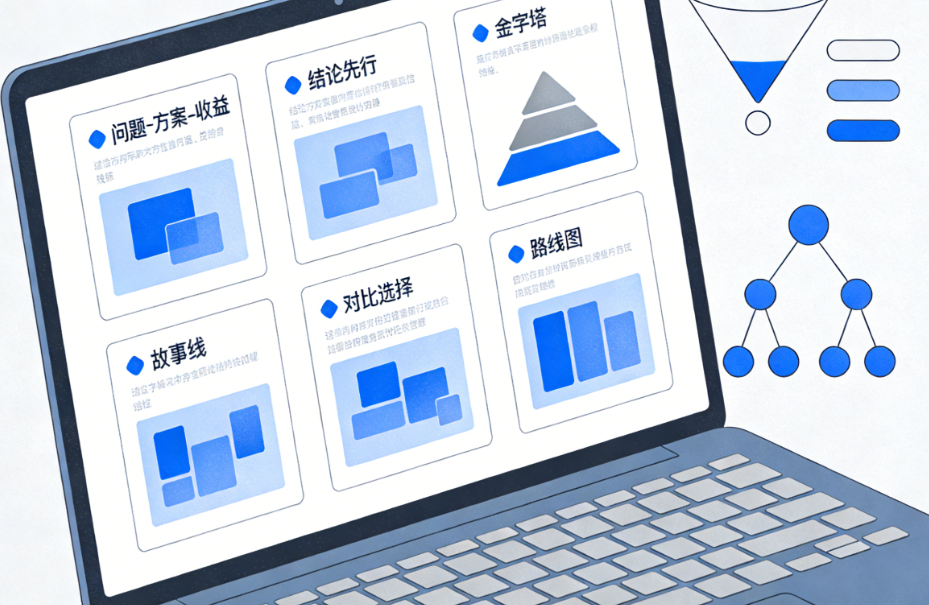
First, the core of a good PPT is not "making it look pretty," but "making it logical."“
The same information, structured differently, can lead to completely different results:
- Report: Leaders need "conclusion + decision points"“
- Roadshow: Investors want "logic + growth + competitive advantage"“
- Post-mortem analysis: The team should follow the "facts-reasons-actions" approach.“
- Training: Trainees should follow the "concept-example-practice" approach.“
DiffMind's advantages are:You don't need to gamble on a structureYou can view all 6 structures on the same screen and choose the most stable one.
two,DiffMind Generate 6 different PPT narrative structures on the same screen.
Step 1: First, define your "scenario variables".“
You only need to clearly state these 4 items:
- Scenario: Weekly meetings/quarterly reviews/project initiation/external roadshows/internal training
- Audience: Boss/Client/Cross-department/Newcomer
- Duration: 3 minutes / 10 minutes / 30 minutes
- Objective: To obtain resources/decision-making/budget/consent/execution
Step 2: Prompt words (can be copied directly)
As a senior consultant, could you please help me generate an "outline structure" for a PowerPoint presentation?
Scenario: [Fill in]; Audience: [Fill in]; Duration: [Fill in]; Goal: [Fill in]
Content Topic: [Fill in] (One sentence)
Known information/data: [Fill in] (optional)
Please provide 6 different narrative structures (for each structure, please include: suggested page count + page title + 3 key points + reasons why it is suitable):
1) Problem-Solution-Benefit (PSB)
2) Conclusion first (Executive summary)
3) Pyramid structure (general-specific-general)
4) Storyline (Background - Conflict - Turning Point - Outcome)
5) Comparison and selection (Comparison and recommendation of options A/B/C)
6) Roadmap/Milestones (Stage Goals, Plans, Risks)
Requirements: The title should be short and impactful, avoiding empty rhetoric.
III. On-screen comparison: Selecting the structure using "3 judgments"
- Audience decision-making habitsLeaders are better suited to drawing conclusions first; reviewers are better suited to making comparisons and selections.
- Information maturityComplete information allows for the use of PSB; incomplete information allows for the use of a roadmap to secure resources first.
- Duration: Start with the conclusion in 3 minutes; 30 minutes can be used to develop the narrative using a pyramid or storyline.
IV. Enhanced Questioning: Transform the outline into a "page-by-page" production checklist
Return the selected structure to DiffMind and let it continue outputting:
- Recommended chart types for each page (bar/line/funnel/Gantt/matrix)
- One sentence of spoken script per page“
- Key data locations on each page, and a list of data that needs to be supplemented.
- A simplified 1-page version (suitable for leaders to read in seconds).
Template for follow-up questions (can be copied)
Based on the following PPT outline, further output will be provided:
1) Recommended chart types and illustrations for each page
2) 30-second spoken script per page (conversational style)
3) A list of data required for each page (who should I ask for this data from?)
4) One-page "High-Level Summary"“
The outline is as follows:
Paste the outline you selected.
Fifth, the points where you will noticeably become faster.
- No longer "starting from page one".“
- First determine the structure, then fill in the content.
- Simultaneous screen comparison reduces trial and error costs
- The output can be directly converted into a table of contents and page titles.