
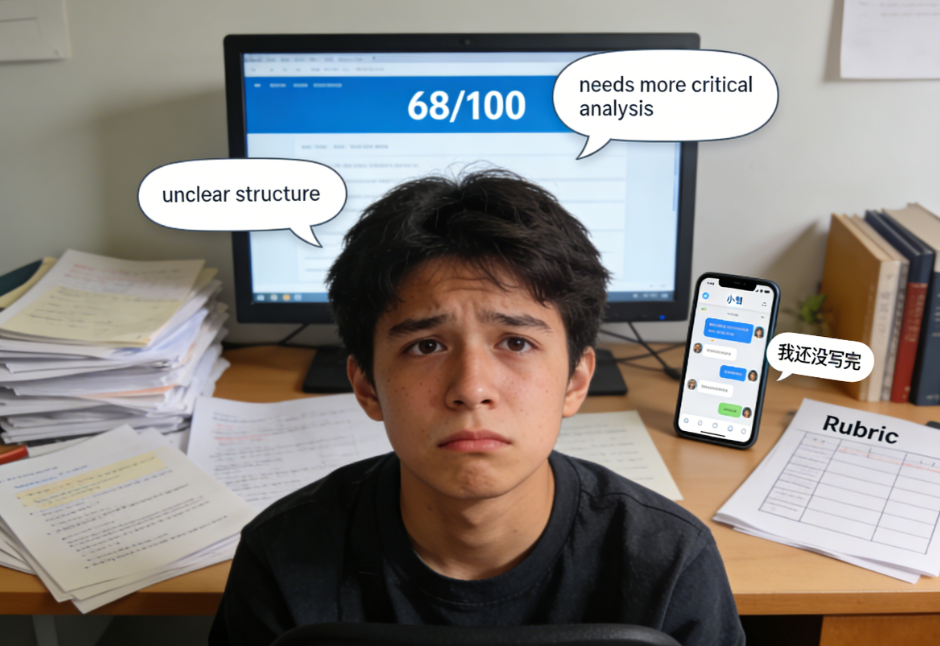
You may be familiar with these moments:
- You attend classes diligently every week, do your reading, and stay up until the early hours, but your grades are always stuck at... 60/70 Unable to get up;
- The teacher wrote a long feedback:“needs more critical analysis / insufficient synthesis / unclear structure”—You can understand each word individually, but when they're put together, you just can't understand how to correct them;
- Group assignments are even more outrageous: you give a reminder two weeks in advance, and your teammate throws in a "draft that looks like it's not finished" on the last night. You're trying to put out the fire while worrying about being implicated.
Many international students search improve grades international studentsI'm not actually looking for motivational platitudes, but rather a systematic approach that can consistently push my score upwards. Here's the conclusion:From Pass to Distinction, the shortest path is not to exert more force, but to use rubrics to deduce the "scoring signal" you want to deliver.
1) Key variables affecting grades: What exactly do teachers use to grade?
You might think teachers are grading "effort," but most courses are actually grading "whether the deliverables are aligned with the rubric." Here are the variables that most often determine whether you stop at 60/70 or rush to Distinction.
Variable A: Rubric Interpretation (Determines the effectiveness of your efforts)
The same word has an "implicit threshold" in rubrics:
- “"clear" does not mean grammatically clear, but rather... Readers don't need to guess what you're trying to prove.
- “Analysis” is not simply restating material, but rather… Explain the causes, mechanisms, and impacts.
- “Critical thinking” is not about criticizing limitations, but rather… Compare, weigh, and propose alternative explanations
If you don't translate rubrics into executable actions, no matter how much you write, it might only result in a "more complete 60 points".
Variable B: Depth of Argumentation (Why your content seems extensive but doesn't earn a high score)
High-scoring assignments are not simply a collection of information, but rather a chain of arguments:
Claim → Evidence → Reasoning → Counterexamples/Limits → So what?
Many assignments in the 60-70 range get stuck because they have a claim and evidence, but the reasoning is weak, or there are no counterexamples.
Variable C: Critical Thinking (the most easily misunderstood option)
The "critical" approach that teachers require typically includes at least two actions:
- contrastThe differences and reasons between different theories/research/case studies on the same issue
- ReflectionWhat are the conditions under which your conclusion is valid? When is it invalid?
If your paragraphs are always "one point + one example", it's difficult to be judged as Distinction level.
Variable D: Structure (not layout, but reader's route)
Typical manifestations of poor structure:
- The introduction provides a lot of background information but lacks a thesis.
- Each paragraph seems to be stating a key point, resulting in a lack of hierarchy.
- The conclusion introduces a new perspective (one of the things teachers find most annoying).
A high-scoring structure is more like a "navigation system": the reader knows which step you are taking in each paragraph.
Variable E: Citations and Academic Integrity (Deductions and Risk Items)
Common points deducted:
- Inconsistent citation style, mismatch between in-text and reference list
- The citations and arguments do not match (using a review article to support a specific conclusion).
- Over-reliance on a few sources and lack of synthesis.
Variable F: Presentation (many people think of it as "making slides", but it actually tests narrative ability)
High-scoring presentations typically focus on three key points:
- One conclusion per page (not a bunch of words per page).
- The logical transition is natural (Why did you move from A to B?).
- Q&A Resilience (Can you set boundaries for your conclusions?)
Variable G: Participation (hidden bonus points, especially in seminars)
Participation doesn't mean talking a lot, but rather:
- Able to extract a point from the reading into a question
- Can you add a comparison/example after someone else's comment?
This will directly affect the teacher's judgment of your "depth of understanding".
Variable H: Group Work (the stage that most needs strategy)
High scores on group assignments are not due to "everyone working hard," but rather:
- Tasks can be broken down for acceptance (who submits what, and what standards are used).
- The style is consistent (it looks like it was written by a team, not pieced together).
This is also what many people need. group assignment help international students The reason is that cross-cultural collaboration is very costly, and processes must be used to reduce risks.
2) Personal backup plan process: From the first week of school to the end of the semester, use rubrics to reverse-engineer high scores for delivery.
Here is a replicable approach to "rubric-based writing": treat the course as an iterative project, rather than a last-minute cramming session.
Week 1: Translate rubric into an "action list" (not just read it once).
Do three things:
- Copy out each of the high-scoring (Distinction/High Distinction) entries in Rubric.
- Each entry should be followed by "observable evidence".“
- For example, "critical analysis" → should at least include contrasting viewpoints + trade-offs + boundary conditions.
- Create a personal grading sheet: use it to self-evaluate every assignment from now on.
Weeks 2-3: Build a "Course Material Library" (Notes should serve delivery).
- Class notes are organized by topic, not by time.
- Each reading entry can generate 3 key points for writing (viewpoint/evidence/limitations).
- Create a glossary: Standard definitions and preferred expressions for the core concepts of this lesson.
The week the assignment is released: Use rubrics to reverse engineer the outline (first determine the "marking points").
What you need to write is not "what I want to say", but "what rating signals I need to show":
- Which part demonstrates synthesis?
- Which passage embodies contrast and reflection?
- Which section demonstrates the rigor of the methodology/evidence?
By assigning rubrics to paragraphs, the structure becomes more stable.
Writing stage: First write the "argument framework," then write the "sentences."“
Suggested order:
- thesis (which can be refuted)
- Each topic sentence (each paragraph only advances one sub-argument)
- Place each piece of evidence in a designated spot (place citations/data/cases first).
- Counterexample/Limited Section (at least one)
Only at the very end should the language be polished. Many people write it the other way around, resulting in beautiful handwriting but loose logic.
48 Hours After Submitting Your Assignment: Turn Feedback into "3 Things You Must Change Next Time"“
Don't treat feedback as comments, treat it as an iteration list:
- Focus on improving only the three areas that most significantly impact the score (e.g., lack of comparison, overly generalized conclusions, unclear structure).
- Write down a specific action for each point: "What should I do next time?"
This step will allow you to make snowballing progress throughout the semester.
Two weeks before final exams: Conduct a "review of frequently deducted points".“
Summarize all the deductions for this semester's assignments on one page: structure/citation/argumentation/expression.
For the final assignment, clear each item one by one from this page.
3)DiffMind How to help you: Turn "effort" into "improvements that can boost your score".“
If you've worked very hard but your score isn't improving, you're usually lacking in: integration skills, argument completion, and stylistic consistency. DiffMind addresses these three areas.
① Quickly integrate class notes/reading/feedback → actionable improvement checklist
The materials you usually use are scattered:
- lecture notes in one document
- Reading highlights in PDF
- Feedback is in the LMS screenshot.
DiffMind can integrate these into: - High-frequency concepts and common test points in this lesson
- The recurring weakness patterns in your assignments (e.g., "lacking synthesis" or "overly strong conclusions")
- The list of executable tasks for the next job (sorted by priority)
This is much more effective than "I'll be more careful next time".
② Fill in logical loopholes: Check the arguments against rubrics to ensure they are adequate and that comparisons and reflections are not lacking.
What DiffMind can do is not "write longer", but align scoring signals:
- Are there supporting evidence for each of your sub-arguments?
- Does it involve conceptual leaps, substitution of concepts, or lack of definitions?
- Is there a lack of handling of opposing viewpoints/counterexamples?
- Does the conclusion exceed the boundaries of evidence (this is a common dividing line in 70+ cases)?
In other words, it turns rubric into a "checklist that can be automatically inspected".
③ Maintain a consistent writing style: Make the assignments resemble high-scoring model essays as a whole.
High-scoring assignments often have a sense of "overall coherence":
- Terminology Consistency
- Use a cautious but discerning tone (avoid absolute terms).
- The paragraph maintains a stable rhythm (topic sentence—evidence—analysis—summary).
DiffMind can unify disjointed content into a single voice, making the final product more like "mature writing" rather than "stitching together multiple versions".
4) Self-help Checklist: By task type + 48-hour sprint checklist before submission
A. High-scoring key points by assignment type
Essay (Argumentative)
- The thesis is clear and refutable.
- Each paragraph contains a topic sentence and develops a sub-argument.
- At least one opposing viewpoint/counterexample + response
- Quotations are used to support key arguments, not for decoration.
- The conclusion does not introduce new perspectives, but only serves to summarize and enhance the meaning.
Report (Research/Experiment/Case Report)
- Method/data description is reproducible
- Results and discussion separated: presented first, then explained.
- Chart numbers, titles, and references must be consistent.
- Limitations and future work are specific and methodological.
Presentation (oral report)
- One conclusion per page, low text density
- Explain clearly in the first 30 seconds: Problem – Method – Conclusion
- There are 3 possible Q&A scenarios (limitations/alternative explanations/applications).
Group Assignment
- Task breakdown for acceptance: deliverable format, word count, and deadline.
- Standardized templates and glossaries (avoid splicing)
- At least one "red team review" (to find logical breakpoints and duplicates) must be conducted before the merger.
B. 48-Hour Sprint Checklist (The Most Lifesaving Set)
- Rate yourself using rubric: For each high-scoring criterion, where is the corresponding evidence in the text?
- Check the structure: Does the introduction provide a thesis and roadmap? Does each paragraph focus on only one main point?
- Perform a "chain of arguments" check: Is the claim-evidence-reasoning a closed loop?
- Include comparisons/reflections: Explicitly state "however/on the contrary/under the conditions of..." at least 1–2 times.“
- Citation verification: In-text and reference list are consistent; key sources are traceable.
- Language consistency: Terms, tenses, and British/American spelling should be consistent; excessively absolute terms should be removed.
- Read aloud for 5 minutes: Where you stumble while reading, that's where the problem lies in logic or sentence structure.
- Allow 2 hours for formatting cleanup (do not change the format within 10 minutes before the deadline).
In conclusion, the shift from Pass to Distinction essentially boils down to "a reproducible system for aligning scoring signals."“
Getting stuck at 60/70 is often not due to a lack of ability, but rather a failure to use rubrics to direct effort towards "scoreable deliverables." When you can do this:
- When school starts, translate "rubric" into "action".
- Each assignment involves reverse-engineering the structure and argument according to rubric.
- Use feedback to iterate into a fixed list of improvements.
You'll find that improving grades isn't some kind of magic trick, but rather an engineering process.
If you want to quickly integrate your notes/reading/feedback into an actionable plan, and complete the arguments and unify your expression style according to rubrics, tools like DiffMind can more consistently translate "effort" into "score improvement".