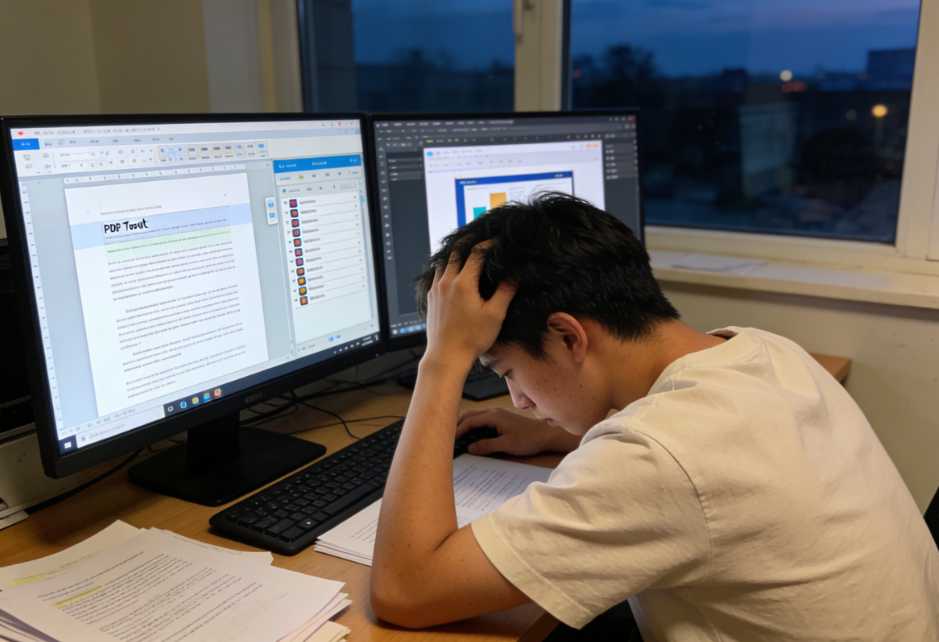

The most common breakdown in writing for international students is not that they don't know how to write, but that they "start to doubt who they really are halfway through writing."
You presented the same quote to three different models:
- Model A: The sentences are as smooth as advertising copy, but the arguments are like cotton candy—sweet, light, and unsupported.
- Model B: The logic is solid and the structure is clear, but the tone is like that of a reviewer, making it sound harsh.
- Model C: It's written like an academic paper, but suddenly two "seemingly real" references are inserted—when you check, they don't exist at all.
Then you copy and paste the three outputs into the same document: congratulations, you have a "message monster" with inconsistent style, inconsistent terminology, disjointed argumentation, and you may even step into the minefield of academic integrity.
This is why many people search for:best ai writing tools / compare ai models writing / academic writing ai for international students / essay help toolWhat you want is not "AI that can write better", but "a more controllable writing process".
1) Three major misconceptions about "multi-model writing": Why do you get more confused the more you use it?
Having multiple models does not necessarily mean being stronger; common failure points are actually more concentrated.
Myth A: Focusing only on fluency, ignoring logic and verifiability.
Many models are particularly good at writing statements that "sound right":
- The conclusion is very convincing: clearly, undeniably, this proves that…
- The argument is weak: it lacks definitions, boundary conditions, and counterexample handling.
- The evidence is dubious: the sources cited are unclear, and some are even outright fabrications.
In academic writing, fluency is just the bare minimum; what truly determines the score is:Argument—Evidence—ReasoningIs it a closed loop?
Myth B: Lack of a unified voice (resulting in the writing being like a collaborative effort where multiple authors don't know each other).
You may have experienced:
- The previous paragraph used "This essay will…" (in the style of a course assignment).
- The next paragraph suddenly changes to "The present study contributes…" (in academic paper style).
- Some paragraphs use American English expressions, while others read like machine translation.
The biggest side effect of using multiple models is inconsistent voices; and tutors/TAs are often very sensitive to this inconsistency.
Myth C: Fragmented output, unable to be transformed into a "deliverable structure"“
Multiple models can easily lead you into “infinite rewriting”:
- You get a lot of “sentences”, but no stable outline.
- Lack of transitions and hierarchy between paragraphs
- Each model is undergoing local optimization, and the overall logic is ignored.
The result is that you have a lot of materials, but you can't put them together into a submittable essay.
2) Multi-model comparative writing "powerhouse list": Don't ask which is the strongest, ask which is the most suitable for this task.
Instead of ranking "who is smarter," it's better to compare models based on "task dimensions" (this is the truly reusable comparison method). Below, following the writing process of international students, common model capabilities are categorized into 5 roles:
Role 1: Idea Generator
Suitable:
- Find an angle, list possible counterexamples, and propose research questions/thesis hypotheses.
risk: - It's easy to get off-topic, giving many points that "sound good but aren't worth writing about."
The output you want:A workable thesis plus 2–4 provable sub-arguments.。
Role 2: Outliner / Academic Structurer
Suitable:
- Break down the question into a scoreable structure: Introduction—Body—Refutation—Conclusion
- Create paragraph hierarchy and topic sentences
risk: - Sometimes, templates are used, resulting in "standard but not sharp" structures.
The output you want:An outline (not a table of contents) showing the order of arguments.。
Role 3: Rewriter/Style Polisher
Suitable:
- Make your sentences clearer, more academic, and more concise.
risk: - It's easy to "smooth things out but end up wrong": semantic drift, changing cautious expressions into absolute expressions.
The output you want:Academic rewriting that retains the original meaning + consistent terminology。
Role 4: Logic & Consistency Checker
Suitable:
- Find the following: breakpoints in the argument, conceptual jumps, missing definitions, missing transitions, and substitutions of concepts.
risk: - This might be overly critical; you need to decide whether to adopt it.
The output you want:Clearly point out "what is missing in each sentence" rather than offering general criticism.。
Role 5: Unifier / Final Editor
Suitable:
- Standardize the voice, terminology, and format of content from multiple sources.
risk: - Without global constraints, it's easy to "rewrite" the text, leading to a loss of detail.
The output you want:Like a final draft written by one person。
Conclusion: The so-called best AI writing tools are not about choosing an "all-rounder," but rather a combination that has a clear division of labor and can ultimately be unified.
3) Personalized backup process: multi-model division of labor for writing (reproducible and submittable)
Below is a process you can directly copy; the goal is:Reduce repeated back-and-forth movements to ensure output can be delivered.。
Step 1: Use "conceptualization" to create a pool of topics and arguments (focus on the points, not the text).
Output requirements:
- One well-defined thesis (the kind that can be refuted).
- 3 main arguments + 1 potential counterexample for each argument
Don't let the model write paragraphs at this stage, otherwise you'll be led astray.
Step 2: Arrange the argument pool into an argumentative order using a "structural" approach (build the framework first).
Output requirements:
- Chapter/Paragraph Order
- Topic sentence of each paragraph
- The required type of evidence for each section (theory/data/case studies/literature)
This step addresses "writability".
Step 3: Fill in the "Evidence and Citation Placeholders" yourself (to avoid fabricating the model).
practice:
- First, insert the literature or classroom materials that you have actually read/are certain to exist into the corresponding paragraphs.
- Uncertain citations are marked "TBD source".“
in principle:Citations must be traceableDon't let any model "invent the source" for you.
Step 4: Use "rewriting" to optimize paragraph-level expression (one paragraph at a time).
Output requirements:
- More academic, clearer, and more concise
- Without changing the meaning, without adding new facts.
It also requires that it retain hedging (e.g., may/suggest/likely) and avoid "over-absolutism".
Step 5: Perform a full audit using a "logic-checking" approach (read like a reviewer).
Checkpoints:
- Should concepts be defined before use?
- Are there transition sentences between paragraphs?
- Should counterexamples/limitations be handled?
- Does the conclusion exceed the scope of evidence?
This time, don't change the writing style, just change the logic.
Step 6: Use the "final unified version" to unify voice and terminology (final global processing).
Output requirements:
- The tone is consistent throughout.
- Terms and abbreviations are consistent
- Use consistent expressions when referencing other language (e.g., consistently use "argue/suggest/find").
Finally, read it through again manually to make sure it sounds like "what you wrote".
4)DiffMind How to transform "multi-model stitching" into a "deliverable final draft"?“
The core challenges of multi-model writing are: numerous outputs, chaotic versions, logical breaks, and inconsistent styles. DiffMind's role is to transform these challenges into controllable steps.
① Quickly integrate outputs from different models: extract the optimal version
You might have: the structure of A, the argument of B, and the expression of C. DiffMind doesn't just do simple piecing together; it can:
- Align and compare multiple versions of the same paragraph
- Extract stronger argument sentences, supporting evidence sentences, and transitional sentences.
- Remove repetitive and contradictory parts.
The result is that you get the "best version after integration", not a "collage".
② Fill in the logical gaps: Complete the parts that "seem correct" but lack logical reasoning.
Typical breakpoints include:
- Jumping directly from the viewpoint to the conclusion, lacking reasoning in between.
- Comparisons begin before concepts are defined.
- It only states the phenomenon without providing an explanation.
DiffMind can make breakpoints explicit and gives you optional completion methods: - Add a limiting condition
- Add an explanation mechanism
- Add a counterexample/respond to the opposing viewpoint
Make your chain of arguments closed loops, instead of just getting by by making it "smooth".
③ Consistent writing style: The final delivery should read like it was written by one person, not pieced together.
DiffMind can unify the entire document into:
- The same academic voice (cautious, verifiable, and not overly absolute).
- A consistent verb system (argue / suggest / demonstrate / indicate)
- Consistent paragraph rhythm and transition methods
This step is... academic writing ai for international students Crucially: your language doesn't have to sound like a native speaker's, but it must sound like "the same author."
5) Self-help Checklist: Model selection criteria + Pre-submission consistency check
A. Model selection criteria (determines how to combine models)
- Will it be possible to fabricate quotations/facts?If there's any probability, don't let it generate references.
- Are you good at structured output?Can it reliably generate outlines and paragraphs?
- Can they abide by the rules?For example, "Don't add new facts" and "Maintain a cautious tone."“
- Are you good at logical auditing?Could you please point out the specific breakpoints and provide repair suggestions?
- Are you good at maintaining a consistent style?Can the terminology, tone, and format be consistent throughout the entire document?
Your goal is not to find the "strongest," but to find the most suitable one for the current situation. essay help tool。
B. Final consistency check before submission (to avoid splicing marks and academic risks)
- Does the thesis align with the conclusion (there was no change of topic midway through the writing)?
- Do each topic sentence contribute to the thesis?
- Have all key concepts been defined and are they used consistently?
- Are all assertions supported by corresponding evidence/citations? (Placeholder: "Assertions based on intuition" are not allowed)
- Did the counterexamples/limitations receive a response (at least one paragraph)?
- Does the tone avoid absolutes (avoid using clearly/proves/undeniably)?
- Are the terms, abbreviations, capitalization, and British/American spelling consistent?
- Does the location of the citation match the reference list (if any) and is it traceable?
- Read it through: Does it sound like it was written by "one person," rather than a mashup of models?
In conclusion, using multiple models is not necessarily more convenient; rather, it requires a greater degree of "division of labor + unification."“
The correct approach to multi-model writing is not to repeatedly ask "which is best," but rather:
- Let different models do what they do best (concept/structure/rewrite/logic/unification).
- Keep citations and facts firmly in your own hands.
- Use an integrator like DiffMind for "version merging + logic completion + style unification"“
Ultimately, what you should submit is an article with a clear structure, closed-loop argumentation, consistent tone, and manageable risk—not a bunch of seemingly impressive fragments.