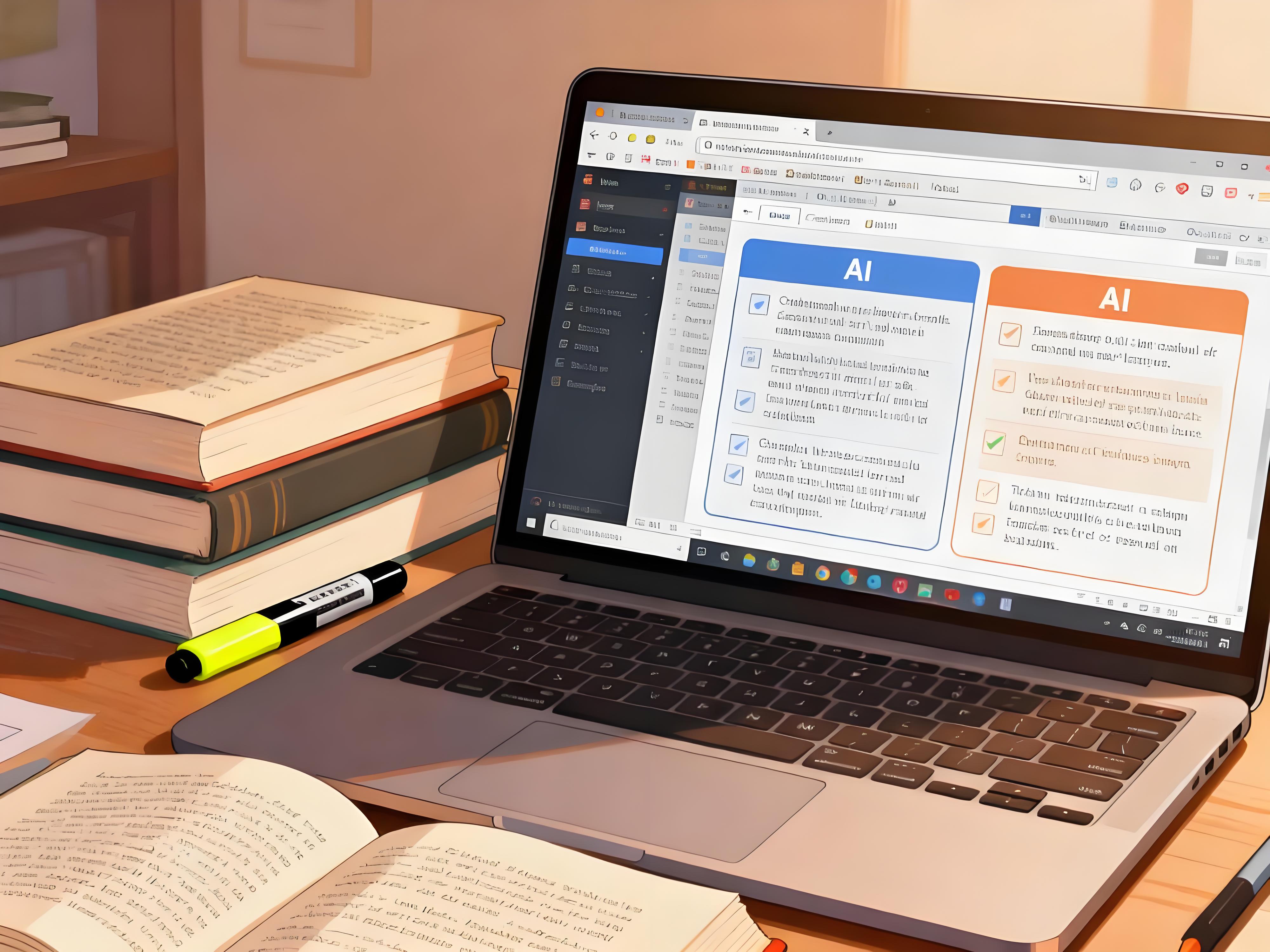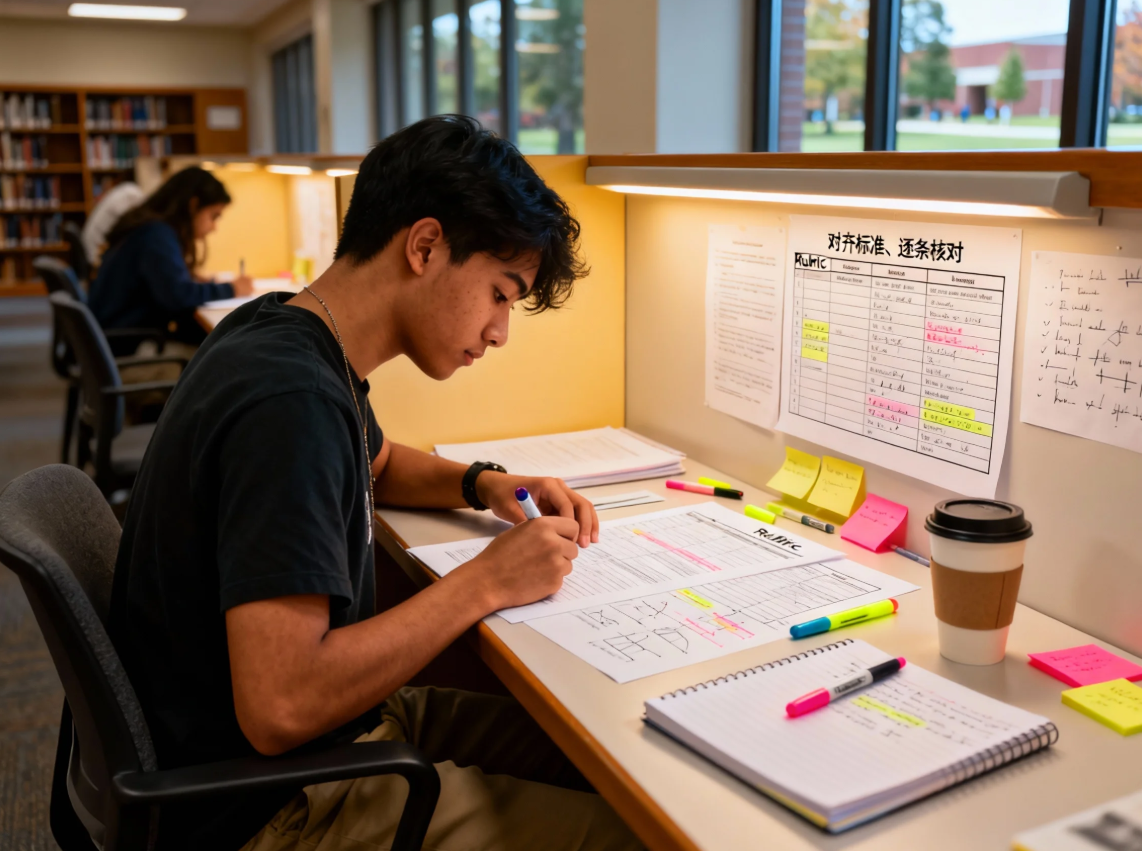

1) Reading list explosion: What is the real situation like for international students?
When you open the course platform, the reading list for Week 5 looks like a shopping list:
- Six essential readings, three of which are theoretical works exceeding 40 pages.
- We were asked to read 10 passages. The teacher said, "You can read them if you're interested, but they'll be used in the discussion."“
- Next week's deadlines include: a literature review outline, a classroom presentation, and a draft of the research question.
You're thinking to yourself:
“"I'll read two articles today, each 40 pages long. It should take me 4-6 hours to finish them carefully, right?"”
As a result, after sitting for 20 minutes, you have already experienced:
- The first page is dense with terminology; long sentences make it hard to concentrate.
- Turning to page 8, I found they were still laying out the background.
- I kept looking back at the previous definitions, and the more I looked, the more I doubted myself.
- Ultimately, it becomes a mechanical page-turning experience, leaving the reader unable to articulate what the author was trying to say.
This isn't just your problem; it's a typical combination of "overloaded reading tasks + high density of academic texts + unclear objectives."
2) Three reasons why you can't "get into" reading (it's not that you're not smart enough)
Reason 1: You are reading all papers using a "read-from-beginning" approach.
In-depth reading is a costly activity and is only suitable for a few key documents.
But the reality is: for the 70% papers in the course readings, you only need to master...What are the claims, what is the evidence, and how do they relate to the course topic?If every single sentence in every article is scrutinized, the whole thing will inevitably fall apart.
Reason two: Your reading goals are unclear, causing your brain to not know "what to focus on".“
Many people have only a vague goal when reading academic papers: "To finish reading it."
But what academic reading truly needs is...Task-oriented,for example:
- Am I doing this for class discussion? I need 3 points to debate.
- Am I using this for writing citations? I need 2-3 restateable chains of argumentation.
- Am I looking for research gaps? What limitations and future directions do I need the authors to acknowledge?
Different goals require different reading methods. Without a clear goal, the brain can only passively receive information, leading to rapid fatigue.
Reason 3: Unfamiliarity with the paper's structure and the abundance of technical jargon cause "delayed comprehension."“
Common pain points in academic papers include:
“The author's true contribution is often hidden in the abstract, the end of the introduction, the discussion, and the conclusion; while the methodology, literature review, and background information may take up a large portion of the text.
If you don't build a structural "map" first, you'll get lost in the details and become more and more uncertain as you read.
3) The "Read Only the Key Points" reading strategy: Turn 40 pages into 40 minutes of effective input.
The core of the following method is:First locate the information, then selectively read it carefully.It's perfect for international students dealing with their reading lists and aligns with what you're looking for:how to read academic papers fast。
Step 0: Ask yourself a question (30 seconds)
Which category does this paper belong to for me?
- Category A: Must be read carefully (strongly related to your assignment/research direction)
- Category B: Requires mastery of viewpoints and evidence (may be used in class discussions/writing).
- Class C: Just know "what it said" (for background and extension)
Once you've categorized them, you won't read each article with the same intensity.
Step 1: Read only the "high information density area" (7–12 minutes)
Reading in this order yields the highest efficiency:
- AbstractFocus on research questions, methods, and conclusions.
- Introduction (last 2-3 paragraphs): Usually, the contribution points are related to the structure of this paper.
- Conclusion/DiscussionKey findings + significance + limitations
- The first and last paragraphs of each section: Usually the main idea and summary of a paragraph
- Charts/models/key formulas (if any)More concise than words
After reading this step, you should be able to answer three questions:
- What problem did the author want to solve?
- What is his/her core claim?
- What evidence/methods support this claim? What is the conclusion?
Step 2: Create a minimal, "referenceable" note (5 minutes)
No need for a long summary, just write 5 lines:
- Thesis (One-sentence argument)
- Evidence (Key Evidence/Case Studies/Data Sources)
- Contribution (novelty compared to other literature)
- Limitation (the author acknowledges the shortcomings)
- Use for me (What viewpoint can I use to support/refute it?)
Step 3: Decide whether or not to do intensive reading (10–30 minutes)
It is only worth reading carefully if it meets any of the following conditions:
- It will become a core reference in your essay.
- You should use it to raise criticisms at the seminar.
- It is the "original" source or frequently cited source of a certain theory/concept.
Otherwise, it is enough to stay at the level of "grasping the structure and viewpoints".
4) DiffMind How to help you understand papers faster and skip unnecessary paragraphs
When you're stuck on 40 pages, what's really holding you back is often:Information filtering和Structural RefinementDiffMind can significantly save time in both of these stages.
4.1 Quickly summarize the paper: First, obtain the "global map"“
You can use DiffMind to quickly summarize papers and get priority access to:
- What is the research question?
- What are the core conclusions of the paper?
- Article structure (what each part does)
- What are the methods and data used (applicable to empirical papers)?
With this "map," it will be easier for you to go back to reading the original text, because you will know which conclusion each paragraph serves.
4.2 Extracting the core ideas: Compressing "what the author wants to say" into reproducible language.
Many academic papers are difficult to read not because of a lack of vocabulary, but because the authors use convoluted writing styles. DiffMind can help you extract the key content into:
- 1 sentence central argument
- 3–5 supporting reasons (chain of arguments)
- Points of contention/assumptions that can be used for classroom discussion
This is especially important for international students: you need more than just "to have seen" it, but to be able to "say it and write it down".
4.3 Help determine which paragraphs can be skipped: Spend your time wisely
When your reading list is overflowing, what you need most is the confidence to skip ahead. DiffMind can help you identify:
- Paragraphs that are purely background information and have little relevance to the course objectives
- Paragraphs that repeatedly explain the same concept
- Minor case studies/further discussions (unless you intend to use it for writing).
- Technical details that are not critical to your current task (such as complex derivations/appendices)
The result is that you are not "lazy and skipping," but rather "reading selectively with evidence."
5) An efficient reading workflow (can be followed directly)
Below is a practical and executable workflow suitable for a large volume of paper input per week:
Workflow: From zero to classroom readiness (25–60 minutes per document)
- Define the task (1 minute)
- Is this article classified as A/B/C? Should I discuss it, write about it, or find a blank space?
- Quickly summarize using DiffMind (3–5 minutes)
- Obtain the research question, core conclusions, structure map, and key concepts.
- Read only the key paragraphs (10–15 minutes)
- Abstract + Introduction (final paragraph) + Conclusion/Discussion
- Scan the beginning and end of each section + charts
- Use DiffMind to extract core ideas and the chain of arguments (3–5 minutes)
- Output: 1 thesis statement + 3 reasons + 1 point for challenge
- Minimum note size: 5 lines (5 minutes)
- Thesis / Evidence / Contribution / Limitation / Use for me
- Decide whether to read in detail (optional, 10–30 minutes).
- Only Category A documents will be read in detail; otherwise, this is the end.
What should you ultimately produce?
- For each article: Be able to clearly explain "what it's saying" in 30 seconds.“
- For each week's reading: be able to come up with 3-5 points for discussion.
- For writing: provide citations, evidence, and limitations, rather than a collection of excerpts.
Conclusion
If you can't get through 40 pages, it's not because you lack self-discipline, but because you've made "intensive reading" your default mode. What international students need most when their reading lists are overflowing is:Goal-driven + Structure-first + Selective close readingBy employing a "read only the key points" strategy, focusing your time on high-information-density areas, and then using DiffMind to quickly summarize, extract core ideas, and identify skippable paragraphs, you'll get closer to your true goal.how to read academic papers fastMoreover, after reading it, one can use it, speak it, and write it.
If you'd like, I can also modify this workflow according to your discipline (social sciences/business/computer science/education/law, etc.) into a more specific "paragraph priority list" and a directly copyable note template.